Can We Drink STP Water? What Treated Sewage Water Is Actually Safe For
Clear, odour-free treated water often tempts people to ask if it is drinkable. It is not. Here is what an STP removes, what it leaves behind, and where treated water belongs.
Today, many housing societies run an STP, and residents ask the same questions again and again. Can we drink STP water? Is it safe after chlorination? What is the TDS limit? This guide answers each one in plain language, so your managing committee can explain it with confidence.
STP water: myth vs fact
Most confusion about STP water comes from five common beliefs. Tap each card to flip it and see the fact.
“If treated water looks clear and has no smell, it is safe to drink.”
Tap to see the factClarity only tells you suspended solids are low. Bacteria, viruses, nitrates and dissolved salts are invisible, so clear water can still be unsafe to drink.
“Low TDS means the water is drinkable.”
Tap to see the factTDS measures dissolved salts only. It says nothing about pathogens or chemical residues. Drinking water must pass many tests, including zero E. coli.
“An STP brings TDS down.”
Tap to see the factBiological treatment targets organic matter, not salts. As a result, treated water TDS stays close to, and often a little above, the supply water.
“Chlorinated STP water is as safe as tap water.”
Tap to see the factChlorine reduces bacteria so people can handle reuse water safely. Drinking water, by contrast, needs a source, multiple barriers and testing to IS 10500.
“Treated water is only good for the garden.”
Tap to see the factWell-treated STP water also serves flushing, cooling towers, car washing, floor washing and construction curing, cutting freshwater demand.
Why can’t we drink STP water, even after treatment?
Because an STP is built to meet reuse and discharge norms, not drinking water standards. In fact, the two sets of rules ask for very different things, and the gap is widest on pathogens.
India’s drinking water standard is IS 10500:2012 from the Bureau of Indian Standards. Above all, it requires zero E. coli in a 100 mL sample. In contrast, treated sewage norms allow a small faecal coliform count. The National Green Tribunal’s April 2019 order set a desirable level below 100 MPN per 100 mL and a permissible level below 230 MPN per 100 mL. Therefore, even a well-run, compliant STP produces water that drinking standards would reject.
| Parameter | Treated STP water (NGT 2019 direction) | Drinking water (IS 10500) | What it means |
|---|---|---|---|
| Faecal coliform / E. coli | Desirable <100, permissible <230 MPN/100 mL | Nil in 100 mL | Biggest gap |
| BOD | <10 mg/L | Not a drinking parameter | Organic load is fine for reuse, not for drinking |
| Suspended solids / turbidity | TSS around 20 mg/L or lower | Turbidity 1 NTU (acceptable) | Drinking water must be far clearer |
| Total nitrogen | <10 mg/L | Nitrate 45 mg/L max | Nutrients still present in reuse water |
| TDS | No specific STP limit | 500 mg/L acceptable, 2000 permissible | An STP does not control TDS |
Regulatory note: State Pollution Control Boards adopt these limits differently, and your plant’s Consent to Operate is the binding document. Figures above are for general understanding, not a compliance reference.
What does an STP actually remove from sewage water?
An STP removes organic matter, suspended solids, odour and most pathogens. However, it does not target dissolved salts. Click each stage of a typical STP below to see what changes and what stays.
Bars are illustrative to show the trend at each stage. They are not measured data. Actual results depend on sewage load, design and maintenance.
What an STP removes
- Organic matter, measured as BOD and COD
- Suspended solids (TSS) and turbidity
- Odour and colour, mostly in the filters
- Most bacteria, after disinfection
- Part of the nitrogen and phosphorus, when designed for it
What it does not target
- Dissolved salts (TDS)
- Hardness from calcium and magnesium
- Many trace chemicals, such as medicine residues
- Every virus and protozoa, to drinking-water levels
Brivith’s patented BIO-DRUM MBBR technology, for example, is designed for treated water with BOD below 10 mg/L, COD below 50 mg/L and TSS below 10 mg/L, subject to site conditions. In other words, that is excellent reuse quality. Even so, it is still reuse quality, not drinking quality. You can read more on our sewage treatment plant page.
What is the TDS limit for STP water?
Standard STP effluent norms in India do not set a specific TDS limit. The 2017 notification and the stricter limits the NGT directed in 2019 focus on pH, BOD, COD, TSS, nitrogen, phosphorus and faecal coliform. However, some State Pollution Control Boards add their own conditions, so always check your plant’s Consent to Operate.
For drinking water, IS 10500 sets TDS at 500 mg/L as the acceptable limit and 2000 mg/L as permissible only when no other source exists. That said, meeting a TDS number alone never makes water drinkable.
Try it: where does your treated water TDS land?
Even so, TDS still matters for reuse. For instance, high-TDS treated water can leave deposits in cooling towers and drip lines. So if your treated water feeds a cooling tower or boiler, you may need a water softener or an RO polishing stage. Our guide to high-recovery RO for water reuse explains how that works.
Which water goes into an STP plant?
An STP treats domestic sewage: black water from toilets plus grey water from kitchens, bathrooms, washbasins and laundry. In short, the plant handles the organic load that daily household use creates.
Two other streams should stay out of the STP:
Rainwater
Send it to rainwater harvesting or storm drains. Otherwise, monsoon inflow dilutes and overloads the plant.
Industrial process effluent
Chemicals, oils and metals need an Effluent Treatment Plant (ETP). See how automated ETPs reduce compliance risk.
Residents also play a part in this. Keep wipes, sanitary products, cooking oil and harsh chemicals out of drains, because they damage the biology that makes treatment work.
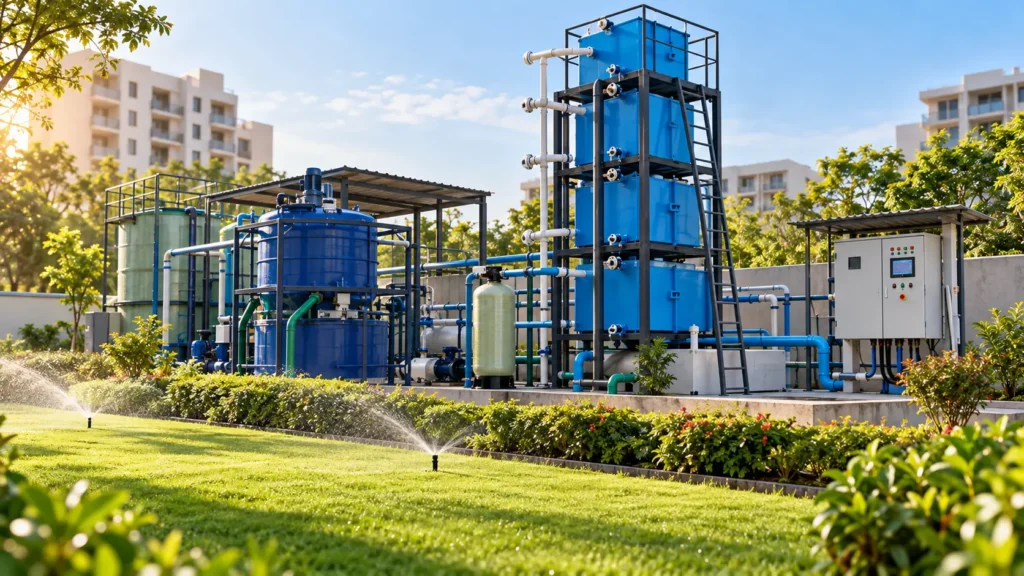
What is treated STP water safe for?
Treated STP water is safe for non-potable uses where people do not swallow it or soak in it. Pick a use below to check it.
Select a use above to see whether treated STP water fits.
Three rules for safe reuse
- Keep pipelines separate. First, recycled water lines should never connect to drinking water lines.
- Label every outlet. Next, mark taps and tanks “Recycled water. Not for drinking.”
- Keep disinfection running. Consistent disinfection protects gardeners, cleaners and residents who handle the water.
Can treated sewage water ever become drinking water?
Yes, but only with advanced treatment far beyond a normal STP. Cities that recycle used water for potable purposes add microfiltration, reverse osmosis and UV disinfection, plus strict monitoring. Singapore’s NEWater, for example, uses these barriers and supplies most of its output to industry.
A building or society STP, however, has neither the design nor the approval for this. Consequently, the right goal for a society is simple: reuse every litre of treated water for flushing, gardening and utilities, so less fresh water is needed in the first place.
How do you know your STP water is good enough for reuse?
Regular lab testing against your Consent to Operate is the only reliable check. Clarity and smell help. Still, they cannot confirm compliance.
- Test on schedule. Send samples to an accredited lab for pH, BOD, COD, TSS and faecal coliform.
- Compare with your consent. Then check results, because your SPCB consent lists the limits that apply to your plant.
- Watch daily signs. Foam, colour, smell or sludge carry-over usually show a problem early.
- Maintain the disinfection unit. Check chlorine dosing or UV lamps regularly.
- Consider remote monitoring. IoT and SCADA alerts flag issues before residents notice them.
Summary
- No, you cannot drink STP water. It is made for non-potable reuse only.
- An STP removes organic matter, solids and most pathogens, but not dissolved salts.
- Treated water TDS stays near, and often a little above, the freshwater supply.
- Use treated water for flushing, gardening, cooling towers and washing, through separate, labelled lines.
- Lab testing against your Consent to Operate is the only reliable quality check.
Frequently asked questions
Can we drink STP water?
No. Treated STP water is meant only for non-potable reuse such as toilet flushing, gardening, cooling tower make-up and washing. An STP is designed to cut BOD, COD, suspended solids and pathogens to reuse or discharge norms, not to meet the IS 10500 drinking water standard. Even well-treated STP water can carry pathogens, nutrients and dissolved salts that make it unsafe to drink.
Is STP water safe for drinking after chlorination?
No. Chlorination reduces bacteria so treated water is safer to handle during reuse, but it does not turn sewage into drinking water. Treated sewage norms in India still allow a small faecal coliform count, while IS 10500 requires zero E. coli in drinking water. Chlorine also does little against dissolved salts, nitrates or trace chemicals.
What is the TDS limit for STP water?
The STP effluent norms notified in India in 2017, and the stricter limits the NGT directed in 2019, focus on pH, BOD, COD, TSS, nitrogen, phosphorus and faecal coliform, not on a specific TDS figure. Some State Pollution Control Boards add their own conditions, so check your plant’s Consent to Operate. For drinking water, IS 10500 sets TDS at 500 mg/L (acceptable) and 2000 mg/L (permissible only when no other source exists).
Which water is used in an STP plant?
An STP treats domestic sewage. That means black water from toilets plus grey water from kitchens, bathrooms, washbasins and laundry. Rainwater should go to rainwater harvesting or storm drains, and industrial process wastewater needs an Effluent Treatment Plant (ETP), not an STP.
What can treated STP water be used for?
Good-quality treated STP water suits toilet flushing, gardening and landscaping, cooling tower make-up, car and floor washing, construction curing and dust suppression. It should not be used for drinking, cooking, bathing, swimming pools or washing food and utensils. Always run recycled water through separate, clearly labelled pipelines.
Does an STP reduce TDS?
No. An STP uses biological treatment, settling, filtration and disinfection, and none of these stages remove dissolved salts in any meaningful way. As a result, treated water TDS stays close to, and often a little above, the building’s freshwater supply. Lowering TDS needs a separate stage such as reverse osmosis.
What does your society use its treated water for?
If your STP water is going unused, or residents are unsure what it is safe for, our engineers can review your plant and reuse plan. Call or WhatsApp +91 98600 88545.
Sources
- Bureau of Indian Standards, IS 10500:2012 Drinking Water Specification. Summary via India Water Portal.
- National Green Tribunal order on STP effluent standards, 30 April 2019, as reported by Business Standard.
- Central Pollution Control Board, effluent and discharge standards.
Protect Every Drop. Make Industries Water Positive.