
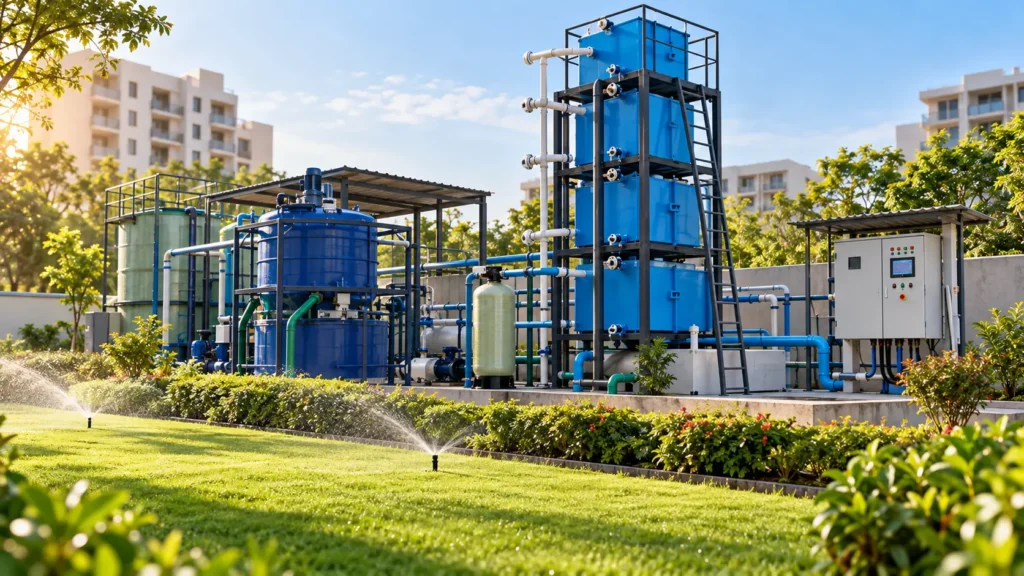
Sewage Treatment Plant (STP): How Patented BIO-DRUM MBBR Cuts Running Cost by Up to 80%
If You Save Water, Water Will Save You.
A sewage treatment plant (STP) cleans domestic wastewater from toilets, kitchens and bathrooms so it can be safely reused for flushing, gardening and cooling towers. It removes organic pollutants, suspended solids, odour and harmful microorganisms before the water leaves your site.
Brivith Engineering designs STPs from 5 KLD to 5000 KLD and above. Our flagship is the patented BIO-DRUM MBBR Technology, which delivers up to 80% lower operating cost and needs 50 to 60% less space than conventional systems. This guide explains how an STP works, what makes BIO-DRUM MBBR different and how to choose the right plant.
*Compared with conventional STP systems. Actual savings depend on site, load and configuration.
What is a sewage treatment plant?
A sewage treatment plant is a system that treats domestic wastewater using physical and biological processes. Typically, it serves residential societies, commercial complexes, hotels, hospitals, schools, townships, industrial campuses and government buildings.
After treatment, the water is suitable for non-potable reuse. Therefore, an STP does two jobs at once: it keeps you compliant with Pollution Control Board norms, and it cuts your fresh water demand by recycling what you already use.
How does a sewage treatment plant work?
A sewage treatment plant works in six stages, from removing large solids to disinfecting the final water. For example, the flow below shows a typical Brivith STP with BIO-DRUM MBBR at its core.
Because the biological stage does most of the work, its design decides your running cost, footprint and odour. That is why BIO-DRUM MBBR focuses on this stage.
What is BIO-DRUM MBBR technology?
BIO-DRUM MBBR is Brivith’s patented version of the Moving Bed Biofilm Reactor process. In any MBBR, bacteria grow as a biofilm on small plastic carriers that move freely in the reactor, which packs far more treatment capacity into a smaller tank.
In addition, BIO-DRUM MBBR builds on this with optimised aeration, a closed aeration system and imported submerged jet aerators. As a result, the plant uses less power, takes less space and runs quietly without foul smell.
| Factor | BIO-DRUM MBBR (Brivith) | Conventional STP |
|---|---|---|
| Running cost | Up to 80% lower | Baseline |
| Space required | 50 to 60% less | Larger tanks and footprint |
| Odour | Closed aeration, odour-free | Open tanks can release odour |
| Noise | Near-zero with submerged jet aerators | Air blowers are often noisy |
| Operator dependency | Very low, highly automated | Higher manual attention |
| Shock loads | Resistant to flow and quality swings | More sensitive to fluctuations |
| Upgrades | Retrofit friendly, no major civil work | Often needs rebuilding |
What are the specifications of a Brivith sewage treatment plant?
A Brivith sewage treatment plant is available in four technologies, several installation formats and multiple construction materials. In short, the table below summarises the standard range.
| Specification | Value |
|---|---|
| Capacity range | 5 KLD to 5000 KLD and above |
| Technology options | BIO-DRUM MBBR (Patented), MBBR, SBR, ASP |
| Treated water BOD | < 10 mg/L |
| Treated water COD | < 50 mg/L |
| Treated water TSS | < 10 mg/L |
| Installation options | Underground, Above Ground, Terrace, Containerized |
| Construction material | RCC, FRP, MSRL, Stainless Steel |
| Automation | Fully automatic with PLC; SCADA and IoT optional |
Unlike suburban sites, tight urban plots often have no room for underground tanks. For instance, a terrace or containerized STP lets a society or hotel add treatment capacity without digging up the site.
What treated water quality does a Brivith STP deliver?
A Brivith STP delivers treated water with BOD below 10 mg/L, COD below 50 mg/L and TSS below 10 mg/L. Because of this quality, the water is suitable for non-potable reuse across your site.
However, discharge and reuse standards vary by state, location and application. Consequently, we design every plant to your consent conditions and local norms. The Central Pollution Control Board and your State Pollution Control Board publish the current standards.
Where can you reuse treated STP water?
You can reuse treated STP water for most non-drinking needs on your site. In practice, that turns wastewater into a steady, free water source.
Toilet Flushing
One of the largest daily water uses in any building.
Gardening and Landscaping
Keeps lawns and plants green without fresh water.
Cooling Tower Makeup
Cuts fresh water draw for HVAC and process cooling.
Utility Applications
Supports washing and other non-potable site uses.
Who needs a sewage treatment plant?
Any building or campus that generates significant domestic wastewater needs a sewage treatment plant. In practice, Brivith STPs commonly serve these applications.
| Application | Application |
|---|---|
| Residential societies and townships | Commercial buildings and malls |
| Hotels and resorts | Educational institutions |
| Hospitals and healthcare | Industrial campuses |
| IT parks and campuses | Labour camps and government projects |
An STP treats domestic sewage. However, if your factory also produces process wastewater, you need an effluent treatment plant as well. Read How Automated ETPs Are Cutting Compliance Risk to understand the difference in approach.
Why choose a Brivith sewage treatment plant?
A Brivith sewage treatment plant is engineered to cost less to run, take less space and need less attention. Here are the eight reasons clients choose us.
Up to 80% Lower Running Cost
Optimised aeration drastically cuts power consumption.
50 to 60% Less Space
Compact design for constrained urban sites.
Odour-Free Operation
A closed aeration system keeps foul smell in check.
Near-Zero Noise
Imported submerged jet aerators run quietly.
Low Operator Dependency
High automation minimises manual intervention.
Minimal Chemical Use
Biological treatment keeps chemical needs low.
Shock Load Resistant
Handles swings in sewage quantity and quality.
Retrofit Friendly
Upgrade existing STPs without major civil work.
What business benefits does an STP deliver?
An STP pays back through lower water bills, regulatory peace of mind and long equipment life. Specifically, clients see five benefits.
- Lower water bills because recycled water replaces fresh water for flushing and gardening.
- PCB and CPCB compliance that helps you avoid penalties and closure notices.
- Return on investment through daily reuse of treated water.
- Low maintenance cost thanks to robust, long-life construction.
- Green building and ESG support for certifications and sustainability reporting.
How do you choose the right sewage treatment plant capacity?
You choose the right sewage treatment plant capacity from your real water use and occupancy, not a thumb rule. To do this, work through these steps with your engineer.
- Count occupancy, including residents, staff, guests and future phases.
- Measure daily water use from meter readings or tanker records.
- Map peak flows, such as mornings, evenings and weekends.
- Set reuse targets for flushing, gardening and cooling towers.
- Check space and access to pick underground, above ground, terrace or containerized.
- Choose automation and AMC based on who will run the plant day to day.
Already have an old or underperforming STP? In many cases, BIO-DRUM MBBR can upgrade it without major civil work, which saves both time and capital.
Key Takeaways
- A sewage treatment plant treats domestic wastewater so it can be reused for flushing, gardening and cooling towers.
- Brivith’s patented BIO-DRUM MBBR delivers up to 80% lower running cost and 50 to 60% space savings versus conventional STPs.
- Treated water meets BOD below 10 mg/L, COD below 50 mg/L and TSS below 10 mg/L.
- Plants range from 5 KLD to 5000 KLD, with underground, above ground, terrace and containerized options.
- Explore the full range on our Products page.
Frequently Asked Questions
What is the cost of a sewage treatment plant?
STP cost depends on capacity, technology, installation type, construction material and automation. For example, a 20 KLD terrace unit costs far less than a 1000 KLD township plant. Brivith quotes after reviewing your occupancy, water use and site layout.
What is the difference between MBBR and BIO-DRUM MBBR?
MBBR uses bacteria growing on moving plastic media to treat sewage in a compact tank. BIO-DRUM MBBR is Brivith’s patented version, with optimised aeration, closed aeration and submerged jet aerators that cut running cost by up to 80%.
Is an STP mandatory for housing societies?
Many states and municipal bodies require STPs for residential projects above a certain size or number of units. Rules vary by location, so check your building approval conditions and State Pollution Control Board requirements.
Does a sewage treatment plant smell?
A poorly designed or maintained STP can release odour from open tanks. By contrast, Brivith’s BIO-DRUM MBBR uses a closed aeration system, which keeps operation odour-free.
Can an existing STP be upgraded to BIO-DRUM MBBR?
Yes. BIO-DRUM MBBR is retrofit and upgrade friendly, so many existing STPs can be upgraded without major civil work. However, a site audit first confirms what your current tanks can support.
Can treated STP water be used for drinking?
No. Treated STP water is meant for non-potable reuse such as flushing, gardening, cooling tower makeup and utility uses. In contrast, drinking water needs separate treatment and testing to potable standards.
Ready to cut your STP running cost?
Book a free consultation. Our engineers will review your occupancy, water use and site, then recommend the right BIO-DRUM MBBR capacity and installation format.
Protect Every Drop. Make Industries Water Positive.
Hi, this is a comment.
To get started with moderating, editing, and deleting comments, please visit the Comments screen in the dashboard.
Commenter avatars come from Gravatar.