
Introduction
Every industrial Reverse Osmosis (RO) plant produces two streams: permeate, the clean water you actually want, and reject (or concentrate), the water that carries away the salts, minerals, and impurities filtered out along the way. For decades, Indian industries have treated reject water as an unavoidable cost of doing business, water purchased, pumped, and paid for, only to be discarded as waste.
That equation is changing. As water tariffs rise, groundwater extraction faces tighter regulation, and Pollution Control Board (PCB) norms around discharge and Zero Liquid Discharge (ZLD) tighten across states like Maharashtra, Gujarat, and Tamil Nadu, industries are being forced to ask a simple but important question: how much of our RO reject water is actually recoverable?
This is where high-recovery RO technology comes in. Rather than accepting standard recovery rates as fixed, high-recovery system design pushes more usable water out of every unit of feed water, reducing freshwater dependency, cutting effluent volumes, and improving the overall economics of water use in manufacturing, pharma, food processing, and process industries.
This article breaks down what RO recovery rate actually means, why conventional systems leave water (and money) on the table, how high-recovery design works, and how to evaluate whether your facility is a good candidate for it.
What Is RO Recovery Rate?
Recovery rate is the percentage of feed water that an RO system converts into usable permeate, rather than sending it out as reject. If a plant takes in 1,000 litres of feed water and produces 700 litres of permeate, its recovery rate is 70%, with the remaining 30% discharged as concentrate.
Recovery rate isn’t a fixed number, it depends heavily on feed water quality, particularly:
- Total Dissolved Solids (TDS) in the raw water
- Hardness (calcium and magnesium content)
- Silica levels, which are especially prone to scaling at high concentration
- Water temperature, which affects membrane performance
- Pretreatment quality ahead of the RO membranes
For most industrial applications, recovery in the range of 50–85% is achievable, depending on these site-specific factors. Higher recovery is possible with the right combination of design, pretreatment, and monitoring, but it always needs to be evaluated against actual feed water characteristics rather than assumed as a standard figure.
Why Conventional RO Systems Leave Recovery on the Table
Many RO installations in India are designed conservatively, often to avoid membrane scaling and fouling issues rather than to maximise water recovery. This is understandable: pushing recovery too high without the right safeguards leads to a common set of problems:
- Scaling: As water is concentrated, dissolved salts (particularly calcium carbonate, calcium sulphate, and silica) can exceed their solubility limits and precipitate onto membrane surfaces
- Fouling: Organic matter, colloids, and biological growth accumulate faster in a more concentrated reject stream
- Reduced membrane life: Scaling and fouling both shorten membrane lifespan and increase cleaning frequency
- Inconsistent permeate quality: As recovery increases without proper controls, salt passage can rise, affecting output water quality
Because of these risks, many standard RO plants are set conservatively, sometimes well below what the feed water could technically support, meaning industries pay for feed water they don’t need to lose.
How High-Recovery RO Design Works
High-recovery RO isn’t a single component, it’s a design philosophy that combines several elements to safely push recovery higher without compromising membrane life or output quality.
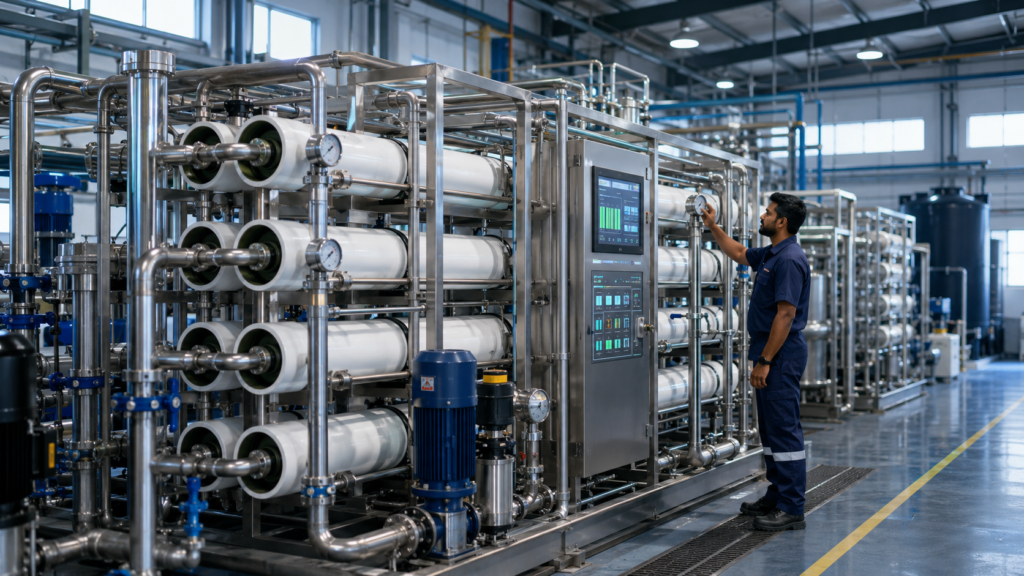
1. Multi-Stage Array Design Instead of a single pass, high-recovery systems use staged membrane arrays (commonly 2-stage or 3-stage configurations), where the reject from one stage becomes the feed for the next. This extracts additional permeate from water that would otherwise be discharged after a single pass.
2. Antiscalant Dosing and Pretreatment Correctly selected antiscalants, matched to the specific scaling risk of the feed water (calcium carbonate, sulphate, or silica-based), allow systems to operate at higher concentration factors without precipitation. This is paired with adequate pretreatment, media filtration, softening, or ultrafiltration, depending on raw water quality.
3. Membrane Selection Low-fouling and high-rejection membrane types are selected based on the specific feed water profile, rather than a one-size-fits-all approach. This directly affects both achievable recovery and long-term membrane life.
4. Energy-Efficient Pumping Multi-stage systems require careful pump and pressure vessel design to maintain adequate flux across each stage without excessive energy consumption. Well-designed systems balance recovery gains against energy cost, rather than achieving higher recovery through brute-force pressure increases alone.
5. IoT and SCADA-Based Monitoring Real-time monitoring of pressure differentials, conductivity, and flow across each stage allows operators to catch early signs of scaling or fouling before they cause a shutdown, critical for systems operating closer to the practical recovery limit of the feed water.
Business Benefits of High-Recovery RO Systems
Lower Freshwater Intake:
The most direct benefit: less raw water needs to be purchased, pumped, or extracted for the same output of usable permeate. For facilities on metered municipal supply or with groundwater extraction limits, this has a direct impact on operating cost and regulatory exposure.
Reduced Effluent and Disposal Load:
A smaller reject volume means less concentrate to manage, whether that’s tankered disposal, evaporation, or feeding into an Effluent Treatment Plant (ETP) or Zero Liquid Discharge (ZLD) system. Since ZLD systems are typically the most capital- and energy-intensive part of a treatment scheme, reducing the reject volume that reaches them can meaningfully improve the overall economics of a ZLD-linked plant.
Support for Regulatory Compliance As several Indian states move toward stricter groundwater extraction norms and ZLD mandates for specific industry categories, reducing dependency on fresh water intake and minimising discharge volume supports easier compliance, though exact obligations vary by state, industry category, and local PCB requirements, and should always be confirmed against current regulations for your specific facility.
Better Return on Existing Infrastructure For facilities that already operate an ETP or ZLD system, feeding it a smaller, more concentrated reject stream (rather than a larger, more dilute one) can improve the efficiency of that downstream investment.
Is High-Recovery RO Right for Your Facility?
High-recovery RO tends to make the strongest business case where one or more of the following apply:
- Feed water is purchased, metered, or extracted under regulatory limits (municipal supply, tanker water, or regulated borewells)
- The facility already operates or is planning a ZLD or advanced ETP system, where reducing reject volume lowers downstream treatment cost
- Water-intensive processes, dairy, food and beverage, textile, pharma, and process manufacturing, where RO is a core part of the water balance rather than a small auxiliary system
- Facilities currently operating RO at conservative recovery rates without a clear technical reason (i.e., recovery was set as a default rather than engineered to feed water conditions)
Facilities with very high feed water TDS, hardness, or silica may still achieve meaningful recovery gains, but the achievable percentage will differ from a facility on relatively cleaner feed water, this is precisely why recovery targets should be engineered from a water analysis, not assumed from a brochure figure.
Design and Selection Considerations
Before specifying a high-recovery RO system, a few steps matter more than the headline recovery number:
- Complete feed water analysis: TDS, hardness, silica, iron, and organic content should all be tested, not estimated
- Site-specific recovery target: Set based on the water analysis, not a generic industry figure
- Pretreatment sizing: Softening, dosing, and filtration systems need to be matched to the actual scaling risk
- Membrane and array configuration: Selected for the specific feed profile and target recovery
- Monitoring and automation: PLC/SCADA-based monitoring becomes more important as recovery targets increase, since the margin for error narrows
This is also where a turnkey, engineering-first approach matters. A high-recovery RO system designed without proper water analysis and pretreatment can end up with more frequent membrane replacement and cleaning — eroding the very savings it was meant to deliver.
The Brivith Approach
At Brivith Engineering LLP, every Industrial RO Plant is custom-engineered around a detailed water analysis rather than a standard template. Our systems are designed for recovery rates in the 50–85% range depending on feed water quality, using appropriately selected membranes, correctly dosed antiscalants, and PLC/SCADA/IoT-enabled monitoring to maintain performance over the system’s operating life.
For facilities exploring higher recovery, integrated ZLD readiness, or simply looking to reduce the freshwater and disposal cost of their existing RO setup, our team conducts a site water audit before recommending a specific recovery target or configuration, because the right number is always determined by your water, not a general industry average.
SUMMARY & KEY TAKEAWAYS
Summary (62 words): Most industrial RO plants discharge more reject water than necessary because they’re designed conservatively rather than engineered to actual feed water conditions. High-recovery RO technology, using staged arrays, correct antiscalant dosing, and IoT-based monitoring, allows facilities to safely push recovery higher, cutting freshwater intake and disposal costs, particularly for industries already investing in ETP or ZLD systems.
Key Takeaways:
- RO recovery rate depends on feed water quality (TDS, hardness, silica), there’s no universal number, only what’s engineered for your water
- High-recovery design combines multi-stage arrays, correct pretreatment, membrane selection, and real-time monitoring to safely increase recovery without accelerating membrane wear
- Facilities with metered/regulated water supply or existing ZLD/ETP investments see the strongest economic case for upgrading to high-recovery RO
FAQs
Q1. What is a good recovery rate for an industrial RO plant?
It depends entirely on feed water quality. Most industrial RO systems operate in the 50–85% recovery range, with the achievable figure determined by TDS, hardness, and silica levels in the raw water, not a fixed industry standard.
Q2. Can I increase the recovery rate of my existing RO plant?
In many cases, yes, but it requires a proper feed water analysis first. Recovery can often be improved through better pretreatment, correct antiscalant dosing, or adding a second-stage array, rather than simply adjusting system settings.
Q3. Does higher RO recovery mean lower water quality?
Not if the system is engineered correctly. Higher recovery increases the concentration of the reject stream, which is why proper antiscalant dosing and membrane selection matter; poorly designed high-recovery systems can affect permeate quality, but well-engineered ones maintain it.
Q4. How does high-recovery RO help with Zero Liquid Discharge (ZLD)?
By reducing the volume of rejected water that needs further treatment, high-recovery RO reduces the load on downstream ZLD or evaporation systems, which are typically the most expensive part of a ZLD scheme to operate.
Q5. What industries benefit most from high-recovery RO systems?
Water-intensive industries with metered or regulated water supply, such as pharma, dairy, food and beverage, and textile manufacturing, see the strongest returns, especially where RO reject currently adds to effluent treatment or disposal costs.
Conclusion
RO reject water isn’t simply a fixed cost of purification, with the right engineering, a meaningful share of it can be recovered as usable water. High-recovery RO technology, built on staged design, correct pretreatment, membrane selection, and real-time monitoring, is helping Indian industries reduce freshwater intake, lower disposal costs, and get more value from their existing water treatment infrastructure.
If your facility is evaluating a new RO system, or reviewing whether an existing one is operating below its potential, a water audit is the right starting point.
Ready to find out your facility’s actual recovery potential?
Request a free water audit and system design consultation from Brivith Engineering
Pingback: Why India's Textile & Dairy Industries Are Rethinking Water Softening at Scale - brivith.com