Textile and dairy plants are rethinking industrial water softening because hard water now hurts them in three places at once: rejected batches, scaled boilers and heat exchangers, and rising chemical and fuel bills. In high-volume plants, these losses compound every shift. As a result, softening is moving from a small utility add-on to a core efficiency system. Plant heads now plan, size, and automate it with the same care they give the boiler itself.
This guide explains what hard water does inside a textile or dairy plant, how large-scale softening works, and what has changed in modern systems. It also shows how to size a softener that fits your process.
What is water hardness, and why does it matter more at scale?
Water hardness is the amount of dissolved calcium and magnesium in water, usually expressed as mg/L as CaCO₃. The U.S. Geological Survey uses this widely referenced scale:
| Hardness (mg/L as CaCO₃) | Classification |
|---|---|
| 0 to 60 | Soft |
| 61 to 120 | Moderately hard |
| 121 to 180 | Hard |
| Above 180 | Very hard |
Scale matters because hardness load grows with volume. For example, a plant using 1,00,000 litres a day of water at 300 mg/L hardness brings in about 30 kg of hardness (as CaCO₃) every day. Over a year, that adds up to roughly 11 tonnes. Not all of it turns into scale. However, every kilogram can deposit on a hot surface or react with dyes and detergents.
Many Indian plants also draw from borewells or tankers. Therefore, hardness often changes from season to season, and a single lab report rarely tells the full story.
How does hard water hurt textile processing?
In textile wet processing, calcium and magnesium react with dyes, soaps, and auxiliaries. This leads to uneven shades, spots, and higher chemical use. The most common problems are:
- Shade variation and dye spots. Some dyes form complexes or precipitates with hardness ions, so batches drift from the approved shade.
- Higher soap and detergent consumption. Hardness ions consume surfactants first. They also form insoluble scum that can settle on fabric and harshen the handle.
- Dependence on sequestering agents. Many dye houses dose chelating chemicals to mask hardness. That becomes a recurring cost on every batch.
- Scale on dyeing machines and boilers. Deposits reduce heat transfer, so machines take longer to reach process temperature.
Each reprocessed batch costs water, steam, chemicals, and machine time. Consequently, even a small rejection rate becomes expensive when a unit runs round the clock.
How does hard water hurt dairy and food processing?
In dairy plants, hard water mainly damages the utility side: boilers, heat exchangers, cleaning systems, and washing lines. Here is where it shows up:
- Boilers. Scale insulates boiler tubes, which raises fuel use and increases the risk of overheating. In India, BIS standard IS 10392 gives feed water guidance for low and medium pressure boilers, so check your boiler maker’s limits against it.
- Heat exchangers and chillers. Scale on the utility side slows heating and cooling, which can affect pasteurisation and chilling cycles.
- CIP (clean-in-place) systems. Hardness reduces detergent performance and can leave mineral films on equipment.
- Can, crate, and bottle washing. Hard water leaves spots and deposits that need rewashing.
Softening does not remove milkstone, since milkstone forms largely from milk itself. Still, hard utility water makes cleaning chemistry work harder, so softening supports a more reliable cleaning routine.
What has changed in industrial water softening?
The biggest change in industrial water softening is the shift from manual, timer-based regeneration to automated, flow-based regeneration with PLC control. Here is how the two approaches compare:
| Factor | Legacy softener | Modern automated softener |
|---|---|---|
| Regeneration trigger | Fixed timer or operator judgement | Metered water volume (flow-based) |
| Salt and water use | Often regenerates too early or too late | Regenerates when resin capacity is actually used |
| Soft water continuity | Gaps during regeneration | Multi-vessel designs can keep supply running |
| Monitoring | Manual log book | PLC control, with optional SCADA or IoT alerts |
| Hardness breakthrough | Often noticed after damage | Caught by routine outlet testing or online monitoring |
| Vessel material | Basic construction | FRP, MSRL, SS 304, or SS 316, chosen for duty |
A timer regenerates on schedule, whether the plant used 40% or 100% of the resin capacity. In contrast, a flow-based system regenerates only after a set volume has passed. For a plant treating lakhs of litres a day, that difference affects salt purchases, rinse water, and supply reliability.
How does a large-scale water softener plant actually work?
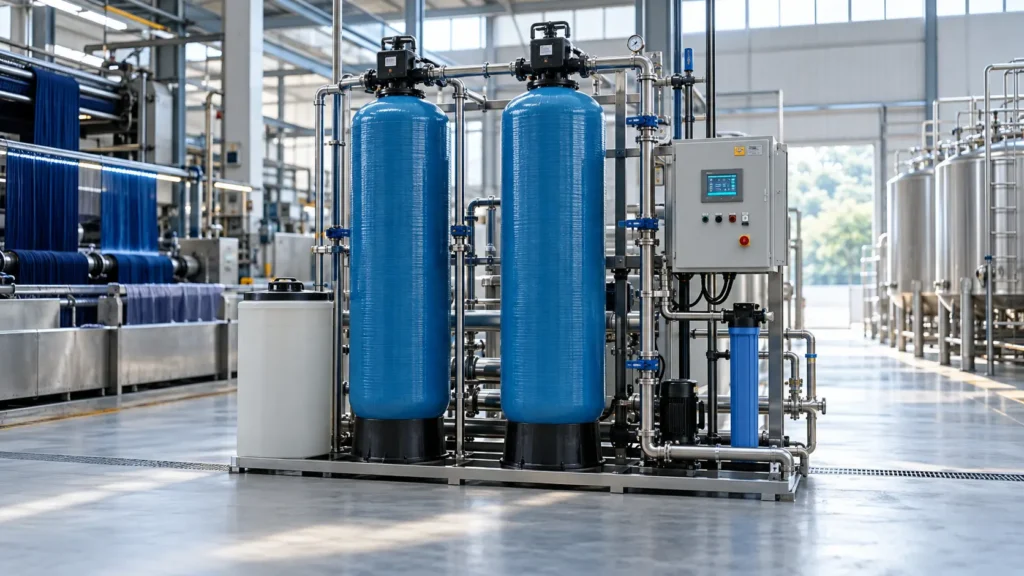
An industrial softener passes hard water through a bed of strong acid cation resin, which swaps calcium and magnesium ions for sodium ions. When the resin is exhausted, the system regenerates it with salt (sodium chloride) brine. A typical cycle runs in five steps:
- Service. Hard water flows through the resin, and soft water flows out to the plant.
- Backwash. Water flows upward to loosen the bed and flush out trapped particles.
- Brine regeneration. Salt brine passes through the resin and restores its sodium form.
- Slow rinse. Water pushes the remaining brine through the bed.
- Fast rinse. The bed settles, and the system returns to service.
Keep two points in mind. First, softening does not reduce total dissolved solids (TDS); it only exchanges one ion for another. If your process needs low TDS, you need RO or DM water instead. Our guides on high-recovery RO and mixed-bed DM plants explain those options. Second, regeneration produces a salty waste stream, so plan its handling early, especially if your site is moving towards Zero Liquid Discharge.
Softener, conditioner, RO, or DM: which one does your process need?
The right choice depends on whether your process needs hardness removed, scaling controlled, or dissolved salts reduced. This table gives a quick comparison:
| System | What it does | Typical fit |
|---|---|---|
| Water softener | Removes calcium and magnesium; TDS stays the same | Dyeing, washing, low-pressure boiler feed, cooling tower makeup |
| Water conditioner | Changes how hardness minerals crystallise; does not remove them | Pipelines, heat exchangers, and hot water lines where scale control is enough |
| RO plant | Removes most dissolved salts | Processes that need low TDS water |
| DM plant | Removes nearly all dissolved ions | High-pressure boilers and critical process water |
For a dye house, a conditioner is usually not a substitute for a softener. Dye and detergent chemistry reacts with hardness ions, and a conditioner leaves those ions in the water.
How do you size an industrial water softening plant?
You size an industrial water softening plant from three numbers: peak flow, inlet hardness, and daily water volume. Then you choose the regeneration pattern around your production schedule. Follow these steps:
- Test raw water across seasons. Check hardness, TDS, iron, and turbidity, because iron and suspended solids can foul resin and may need pretreatment.
- Map demand by user. List peak and average flow for boilers, dyeing machines, CIP, washing, and cooling towers.
- Calculate the daily hardness load. Multiply hardness by volume, as in the example above.
- Pick regeneration frequency and vessel setup. Decide whether a single vessel works or your plant needs twin vessels for continuous supply.
- Choose the automation level. Options range from manual to semi-automatic to fully automatic PLC control.
- Plan salt storage and regeneration waste. Size the brine tank and confirm how the waste stream will be handled.
Brivith designs water softener plants from 500 LPH to 5,00,000 LPH and above, with operating pressure of 2.5 to 7.0 kg/cm². Actual performance always depends on raw water quality and site conditions.
What returns can textile and dairy plants expect?
Returns from softening come from lower chemical use, fewer reprocessed batches, less descaling downtime, and steadier boiler performance. The exact figures depend on your hardness, water volume, and current practices.
So, measure before you install. Record these baselines for at least one month:
- Fuel used per tonne of steam
- Sequestering agent and detergent consumption
- Descaling frequency and downtime hours
- Batch reprocessing rate
Then compare the same numbers three months after commissioning. The Bureau of Energy Efficiency also publishes guidance on boiler efficiency that can help frame your fuel tracking. This way, the business case rests on your own plant data rather than generic claims.
How does Brivith Engineering approach industrial water softening?
Brivith Engineering designs every softener from a detailed raw water analysis and a review of each point of use. Our Water Softener Plants use food-grade strong acid cation resin. They come with manual, semi-automatic, or fully automatic regeneration, and PLC controls support timer or flow-based operation. Vessel options include FRP, MSRL, SS 304, and SS 316.
With over 25 years of water treatment engineering experience, we handle design, manufacturing, installation, commissioning, and AMC support as one turnkey package. To discuss your plant’s water, write to sales@brivith.com or call +91 98600 88545, or request a consultation.
Summary
- Textile and dairy plants treat large volumes of water, so hardness damage compounds quickly.
- In textiles, hardness causes shade variation, spots, and higher chemical use. In dairy, it mainly scales boilers, heat exchangers, and cleaning systems.
- Modern industrial water softening uses automated, flow-based regeneration, which matches salt and water use to actual demand.
- Softeners remove hardness but not TDS. Use RO or DM where dissolved salts matter.
- Size the plant from peak flow, inlet hardness, and daily volume, and measure a baseline before installing.
Frequently Asked Questions
1. What hardness level means a plant needs a water softener?
It depends on how you use the water, not on one fixed number. Boilers and dyeing processes usually need water with hardness close to zero, while other uses tolerate more. Test your raw water, then compare it against your boiler maker’s limits and your process requirements.
2. Does a water softener reduce TDS?
No. A softener swaps calcium and magnesium for sodium, so TDS stays roughly the same. If your process needs low TDS water, you need an RO or DM plant.
3. How often does an industrial softener need regeneration?
Regeneration frequency depends on resin volume, inlet hardness, and daily water use. A flow-based automatic softener regenerates after a set volume of water has passed, rather than on a fixed timer. As a result, it matches regeneration to actual demand.
4. Is softened water suitable for dairy and food plants?
Softened water is widely used for dairy utilities such as boilers, cooling towers, CIP, and washing. Softening adds some sodium, so check applicable food safety requirements before using it in product-contact applications. Brivith uses food-grade cation exchange resin in its softener plants.
5. Can a water conditioner replace a softener in a dye house?
Usually not. A conditioner changes how hardness minerals form scale, but it does not remove them. Since dyes and detergents react with hardness ions, dye houses generally need true hardness removal.
6. How much does an industrial water softener plant cost?
Cost depends on capacity, inlet hardness, vessel material, and automation level. A 5,000 LPH manual system and a 1,00,000 LPH automatic multi-vessel plant sit in very different ranges. Share your water analysis and flow requirement with the supplier for an accurate quote.