
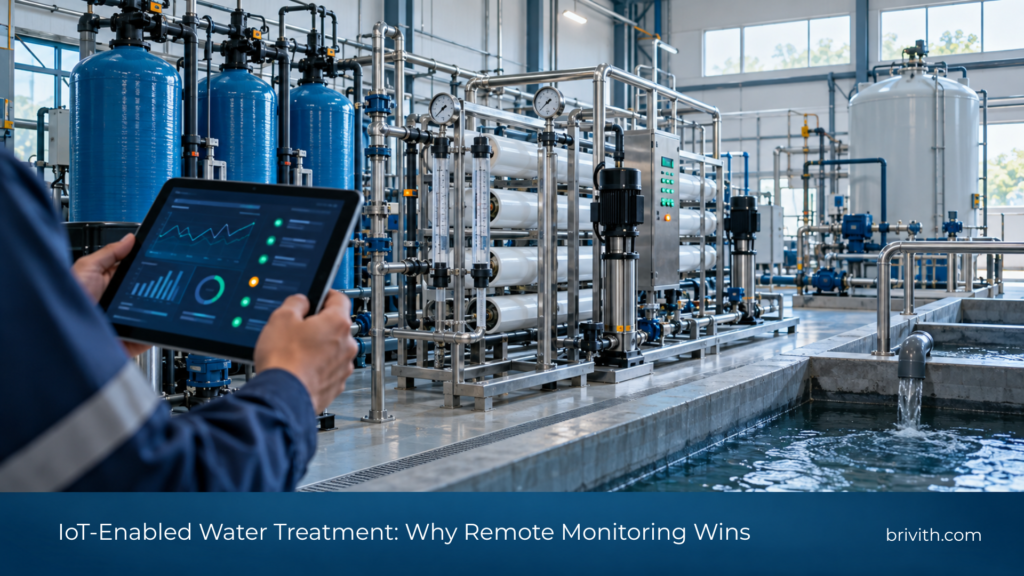
IoT-Enabled Water Treatment: Why Remote Monitoring Is Becoming the Industry Standard, Not a Luxury
A register filled at 9 am tells you nothing about 2 am. Here is what live monitoring tracks, why regulators are pushing for it, and how to add it to the plant you already have.
IoT-enabled water treatment means your STP, ETP, RO or softener plant reports its own health, in real time, to a screen you can check from anywhere. A few years ago, most Indian plant heads saw this as a premium add-on. Today, regulators, auditors and operating budgets all push the other way. For many facilities, remote monitoring has quietly moved from “nice to have” to baseline expectation.
This guide explains what IoT monitoring actually tracks, why it is becoming standard, and how to decide whether your plant needs it now.
What is IoT-enabled water treatment?
IoT-enabled water treatment is a plant fitted with online sensors, a data logger or PLC, and a cloud or SCADA dashboard that records key parameters continuously.
Instead of an operator writing readings in a register twice a shift, the system captures data every few seconds or minutes and stores it automatically. A typical setup has four layers:
- Sensors and analysers measure flow, pH, pressure, TDS, dissolved oxygen, tank level and similar parameters.
- A PLC or data logger collects the readings and runs automated sequences, such as backwash or regeneration.
- A connectivity layer (GSM, 4G, Wi-Fi or Ethernet) sends the data to a server.
- A dashboard or SCADA screen shows live values, trends, alarms and reports on a laptop or phone.
In short, SCADA controls and visualises the plant locally, while IoT extends that visibility beyond the plant boundary.
Why is remote monitoring becoming the industry standard in India?
IoT-enabled water treatment is becoming standard because regulators increasingly expect continuous data, skilled operators are hard to retain, and unplanned failures cost far more than sensors do.
Four pressures drive the shift.
Regulators already expect continuous, online data
The Central Pollution Control Board (CPCB) set the direction years ago. It published guidelines for Online Continuous Effluent Monitoring Systems (OCEMS) in November 2014. It also directed state boards to make 17 categories of highly polluting industries install these systems and connect them to regulator servers.
Of course, your plant may not fall under those 17 categories today. However, the direction is clear: regulators increasingly prefer live data over handwritten logs. You can read CPCB’s own standard operating procedure for OCEMS at STPs for a sense of what regulators look for.
Always confirm the exact requirement for your facility with your State Pollution Control Board, because consent conditions vary by industry, size and location.
Manual logs leave compliance gaps
A register filled at 9 am and 5 pm tells you nothing about what happened at 2 am. For example, a blower trip, a dosing pump failure or a pH swing can run for hours before anyone notices.
Consequently, the plant may discharge out-of-spec water while the paperwork still looks clean. Continuous logging closes that gap. It also gives you a timestamped record if an inspector asks questions.
Skilled operators are scarce
Today, many housing societies and mid-sized factories run their water plants with one or two operators, often shared across shifts or sites. When that operator goes on leave, plant knowledge walks out the door. Remote monitoring lets a supervisor, consultant or AMC team watch several plants at once. As a result, the plant depends less on one person’s memory.
Failures cost more than prevention
A fouled RO membrane, a scaled boiler or a struggling STP bioreactor rarely fails overnight. Instead, it drifts. Pressure creeps up, recovery drops, and dissolved oxygen falls. IoT dashboards show those trends early, so your team can act before the drift turns into a breakdown, a membrane replacement or a regulatory notice.
What does an IoT water treatment system actually monitor?
An IoT water treatment system monitors the handful of parameters that signal plant health and discharge quality. The exact list depends on the plant type.
| Plant type | Key parameters to monitor | Why it matters |
|---|---|---|
| STP (MBBR, SBR, ASP) | Inlet and outlet flow, dissolved oxygen, pH, blower run hours, tank levels | Confirms the biology is healthy and treated water is fit for reuse |
| ETP | pH, flow, TSS, BOD/COD (where online analysers are fitted), dosing pump status | Supports discharge compliance and dosing accuracy |
| Industrial RO | Feed and permeate TDS, feed and reject pressure, differential pressure, recovery, flow | Flags membrane fouling and scaling early |
| Water softener | Outlet hardness, flow totaliser, regeneration cycles, brine level | Prevents hardness breakthrough into boilers and process lines |
| DM plant | Conductivity, silica (where required), pH, regeneration status | Protects high-pressure boilers from impurities |
However, not every plant needs every sensor. A good design starts with the parameters that drive your compliance and your equipment risk. Then it adds more only where they earn their place.
How does remote monitoring compare with manual logging?
Remote monitoring captures continuous, timestamped data and raises alarms instantly. Manual logging, by contrast, captures a few snapshots a day and depends on someone noticing a problem.
| Factor | Manual logging | IoT remote monitoring |
|---|---|---|
| Data frequency | A few readings per shift | Continuous (seconds to minutes) |
| Night and holiday coverage | Limited | Full, 24×7 |
| Fault detection | After someone notices | Instant SMS, app or email alert |
| Record integrity | Handwritten, easy to miss or backfill | Timestamped and stored automatically |
| Trend analysis | Rarely done | Built-in charts and reports |
| Multi-site visibility | Needs site visits | One dashboard for all plants |
| Audit readiness | Registers must be compiled | Reports export on demand |
IoT-enabled water treatment does not replace the operator. Rather, it gives the operator, the plant head and the service team the same live picture.
Which facilities benefit most from IoT-enabled water treatment?
Facilities that face regulatory scrutiny, run plants around the clock, or manage several sites benefit most.
Is IoT-enabled water treatment worth the investment for a mid-sized plant?
For most plants that run daily and carry compliance or equipment risk, yes.
The monitoring layer usually costs a fraction of the plant itself, and one avoided membrane replacement, boiler descaling job or regulatory notice can go a long way toward covering it. That said, payback depends entirely on your plant size, parameters and failure history. So ask your supplier for a site-specific estimate rather than a generic figure.
When you build the business case, weigh these cost areas:
- Avoided breakdowns: early alerts on pressure, DO or hardness trends.
- Lower consumables: better-timed regeneration, backwash and chemical dosing.
- Fewer site visits: your AMC team can diagnose many issues remotely first.
- Compliance protection: continuous records reduce the risk of penalties or closure notices.
- Management time: reports generate automatically, so nobody has to compile registers.
Can you add IoT monitoring to an existing water treatment plant?
Yes. Most existing STPs, ETPs, RO plants and softeners can move to IoT-enabled water treatment through a retrofit, without rebuilding the plant.
A practical retrofit follows five steps:
- Audit the plantIdentify which parameters matter for compliance and equipment protection.
- Check existing instrumentsReuse working flow meters, pressure transmitters and PLCs where possible.
- Add sensors and a data loggerFill the gaps with online sensors and a logger or PLC upgrade.
- Set up connectivity and dashboardsConfigure alerts, user access and report formats.
- Train the teamMake sure operators and managers know how to read alarms and act on them.
Because retrofits build on what already works, many plants phase the upgrade. They start with critical parameters and expand later.
What should you look for in an IoT water treatment partner?
For IoT-enabled water treatment, look for a partner who understands the treatment process first and the software second.
After all, a dashboard is only as good as the engineering behind the sensors, their placement and their calibration. Ask these questions before you sign:
- Do they design the treatment process, or only supply instruments?
- Will they recommend parameters based on your plant, rather than a fixed package?
- How do they handle sensor calibration and cleaning under AMC?
- Can the system alert several people by SMS, app or email?
- Can you export data in the formats your EHS team and auditors need?
- Can the system connect to regulator portals if your consent conditions require it?
How does Brivith Engineering approach IoT and SCADA monitoring?
At Brivith Engineering, we treat IoT-enabled water treatment as part of plant design, not a bolt-on. Our STPs, including the patented BIO-DRUM MBBR range, and our Industrial RO, water softener, ETP and DM plants come with PLC automation and optional SCADA and IoT monitoring. We select parameters after a site assessment, so you track what actually protects your compliance and your equipment.
Our team brings 25+ years of water treatment engineering experience. We also retrofit monitoring onto existing plants and back every installation with AMC support.
Summary: key takeaways
- IoT-enabled water treatment uses online sensors, a PLC or logger, and a dashboard to track plant health continuously.
- CPCB has steadily pushed industries toward online continuous monitoring, and that direction keeps widening.
- Remote monitoring closes the gaps that manual logs leave, especially at night, on holidays and across multiple sites.
- Most existing plants can add IoT monitoring as a phased retrofit.
- The right partner designs monitoring around your process, not around a fixed software package.
Want to know what your plant is really telling you?
Our engineers will assess your STP, ETP, RO or softener and recommend the parameters worth monitoring. No generic packages.
Or write to sales@brivith.com
Protect Every Drop. Make Industries Water Positive.
Frequently asked questions
What is the difference between SCADA and IoT in water treatment?
SCADA monitors and controls a plant, usually from a local control room or panel. IoT sends plant data over the internet to a cloud dashboard you can open from any phone or laptop. Many modern plants use both: SCADA for on-site control and IoT for remote visibility and alerts.
Is online monitoring mandatory for water treatment plants in India?
It is mandatory for some facilities, not all. Specifically, CPCB has directed the 17 categories of highly polluting industries, common effluent treatment plants and certain other facilities to install online continuous monitoring and connect it to regulator servers. For other plants, requirements depend on your consent conditions, so check with your State Pollution Control Board.
How much does IoT monitoring cost for a water treatment plant?
In short, cost depends on plant type, capacity and the number of parameters you monitor. A basic flow, pressure and alarm package costs far less than a setup with online BOD/COD analysers. The best approach is a site assessment, which lets your supplier recommend only the sensors your plant genuinely needs.
Can IoT monitoring work if the site has weak internet?
Yes. Most data loggers store readings locally and upload them once the connection returns, so you do not lose data during outages. Plants in remote areas often use GSM or 4G modules instead of wired broadband.
Does IoT monitoring replace the plant operator?
No. IoT monitoring supports the operator rather than replacing them. It handles continuous data capture and alerts, while the operator still handles physical checks, cleaning, sludge handling and corrective action. In practice, it makes a small team far more effective.
Which parameters should a housing society STP monitor remotely?
Typically, most society STPs benefit from monitoring inlet and outlet flow, dissolved oxygen in the aeration tank, treated water pH, blower and pump status, and tank levels. These parameters show whether the biology is healthy and whether treated water is fit for flushing and gardening. Your STP supplier can add more based on local norms and reuse plans.