
Introduction
For pharma and chemical plant managers, a Pollution Control Board (PCB) notice is one of the most disruptive events that can hit a facility, causing production holdups, penalties, and reputational damage, often triggered by something as simple as an effluent parameter drifting out of range overnight, unnoticed.
Manually operated Effluent Treatment Plants (ETPs) depend heavily on operator vigilance: correct dosing, timely sludge handling, accurate log entries, and consistent monitoring across every shift. In high-throughput pharma and chemical units, even a well-trained team can miss a deviation during a night shift or a weekend, and by the time it’s caught, non-compliant effluent may already have been discharged.
Automated ETPs are changing this equation. By combining real-time sensors, PLC-based process control, and remote monitoring, they reduce the dependency on manual intervention and close many of the gaps that lead to compliance failures. This article breaks down how automation actually reduces compliance risk, what to look for in an automated ETP, and where the real ROI comes from, beyond just avoiding penalties.
Why Manual ETP Operations Are a Compliance Liability
Most PCB violations at pharma and chemical facilities don’t stem from a fundamentally flawed treatment process — they stem from operational inconsistency. Common failure points in manually run ETPs include:
- Inconsistent chemical dosing: Operators over- or under-dosing coagulants, flocculants, or neutralizing agents based on visual judgment rather than measured parameters
- Delayed response to load spikes: Sudden changes in effluent volume or strength (common in batch pharma processes) that aren’t caught until downstream parameters are already affected
- Manual log errors or gaps: Paper-based or spreadsheet logging that is incomplete, backdated, or inconsistent across shifts
- Sludge handling lapses: Irregular sludge wasting that leads to process upsets and poor settling
- Limited visibility for management: Plant heads and compliance officers often only find out about a deviation after the fact, sometimes only during a PCB inspection
None of these are due to a lack of effort from operators; they’re structural limitations of a system that depends on constant, error-free human monitoring, 24 hours a day, every day of the year.
What “Automated ETP” Actually Means
An automated ETP is not simply an ETP with a control panel. A genuinely automated system typically integrates:
1. Online Sensors for Key Parameters: Continuous monitoring of pH, TSS (Total Suspended Solids), flow rate, and, in more advanced setups, COD/BOD proxies and DO (Dissolved Oxygen), replacing periodic manual sampling with continuous data.
2. PLC-Based Process Control: Programmable Logic Controllers automatically adjust dosing pumps, aeration blowers, and valve sequences based on live sensor input, rather than relying on an operator’s manual setpoint changes.
3. SCADA / IoT Remote Monitoring: Supervisory Control and Data Acquisition (SCADA) systems, often paired with IoT connectivity, allow plant managers and compliance teams to view live plant status remotely, from a phone or laptop, and receive alerts when parameters approach or breach set thresholds.
4. Automated Data Logging: Every reading, dosing event, and alarm is time-stamped and stored digitally, creating an auditable record that’s far harder to dispute or falsify than handwritten logs, useful both for internal reviews and PCB inspections.
5. Alarm & Alert Systems: Automatic SMS/email/app alerts when a parameter drifts outside the compliant range, allowing corrective action before discharge occurs rather than after.
How Automation Directly Reduces Compliance Risk
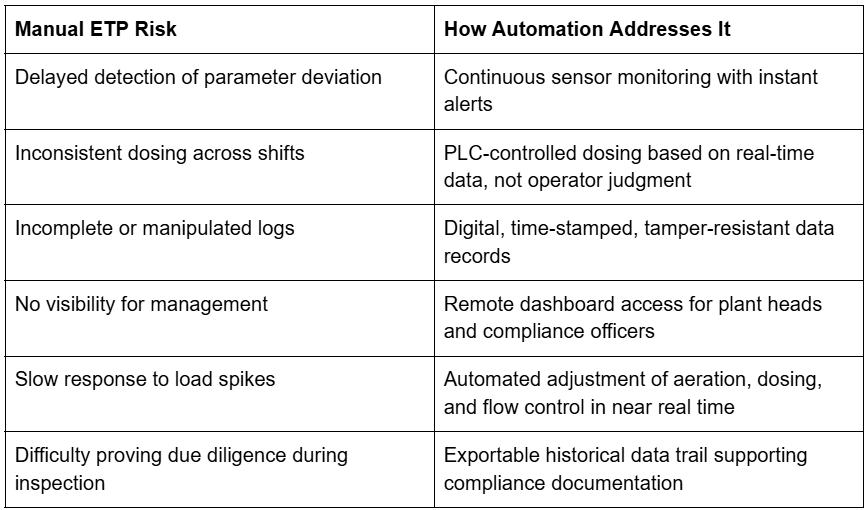
It’s important to be clear that automation reduces risk; it does not eliminate the need for a properly designed treatment process, correctly sized for the specific effluent characteristics of a pharma or chemical unit, or the need for periodic calibration, sensor maintenance, and skilled oversight. Automation is a risk-reduction layer on top of sound process engineering, not a replacement for it.
Why This Matters More for Pharma & Chemical Plants Specifically
Pharma and chemical effluent streams tend to be more variable and more sensitive than typical industrial or domestic wastewater, for several reasons:
- Batch processing creates sudden, irregular load and concentration spikes rather than steady flow
- Variable effluent composition depending on the product being manufactured at a given time
- Presence of active pharmaceutical ingredients (APIs) or process chemicals that require tighter, more consistent treatment control
- Higher regulatory scrutiny, given the sector’s environmental sensitivity and public health linkage
These factors make manual, judgment-based operation particularly risky; the margin for error is smaller, and the consequences of a miss are proportionally higher.
Cost Considerations: Automation vs Manual Operation
Automation does involve a higher upfront capital cost compared to a basic manual ETP, primarily due to instrumentation, PLC/SCADA hardware, and integration. However, the total cost of ownership picture often looks different when you factor in:
- Reduced chemical consumption from precise, sensor-driven dosing instead of manual over-dosing (a common safety margin operators build in when unsure)
- Lower risk of production stoppage due to a compliance violation or PCB-ordered shutdown
- Reduced dependency on highly experienced round-the-clock operators, since the system handles routine control decisions
- Fewer process upsets, which otherwise lead to re-treatment costs and sludge disposal inefficiencies
The actual payback period depends heavily on plant size, effluent characteristics, existing infrastructure, and local operating costs, so it’s best evaluated through a site-specific assessment rather than a generic industry figure.
What to Evaluate Before Automating Your ETP
If you’re considering upgrading an existing manual ETP or specifying automation for a new plant, key questions to ask your engineering partner include:
- Which parameters actually need continuous online monitoring for your specific effluent profile?
- Is the PLC logic designed around your plant’s real operating patterns (batch loads, shift changes, seasonal variation)?
- Can the SCADA/IoT system generate reports in a format useful for PCB submissions and internal audits?
- What is the maintenance and calibration schedule for the sensors, and who is responsible for it?
- Does the system have a manual override for maintenance or emergency scenarios?
A well-designed automated ETP should make compliance easier to demonstrate, not just easier to achieve internally.
How Brivith Engineering Approaches Automated ETPs
Brivith Engineering LLP designs and delivers turnkey ETP systems with PLC, SCADA, and IoT automation options, customized to the specific effluent characteristics, capacity requirements (1 KLD to 5000 KLD), and compliance obligations of pharma, chemical, and process industry clients. Our approach starts with a detailed water and effluent audit, followed by a treatment design that matches your actual operating conditions, not a generic template, with automation layered in to reduce operator dependency and give management real visibility into plant performance.
BLOG SUMMARY
Manual ETP operations expose pharma and chemical plants to compliance risk through inconsistent dosing, delayed deviation detection, and incomplete records. Automated ETPs, using online sensors, PLC control, and SCADA/IoT monitoring, replace guesswork with real-time, data-driven treatment, giving plant managers better visibility and a stronger audit trail while reducing dependency on constant manual oversight.
Key Takeaways:
- Most ETP compliance failures stem from operational inconsistency, not process design flaws
- Automation (sensors + PLC + SCADA/IoT) enables real-time detection and correction before non-compliant discharge occurs
- Automation reduces risk but doesn’t replace the need for sound treatment design and periodic maintenance
FAQs
Q1: What makes pharma and chemical plant effluent harder to manage than other industrial wastewater?
Pharma and chemical effluent often varies significantly due to batch manufacturing processes, changing product lines, and the presence of process chemicals or active ingredients, making consistent manual control more difficult than for steady-flow industrial streams.
Q2: Can an existing manual ETP be upgraded to automation, or does it require a new plant?
In many cases, existing manual ETPs can be retrofitted with sensors, PLC controls, and SCADA/IoT systems, depending on the existing civil and mechanical infrastructure. A site assessment is needed to confirm feasibility for a specific plant.
Q3: Does an automated ETP eliminate the need for an operator?
No. Automation reduces dependency on constant manual judgment for routine control decisions, but skilled personnel are still needed for oversight, maintenance, calibration, and handling exceptions.
Q4: How does automation help during a PCB inspection?
Automated systems maintain digital, time-stamped records of parameters and dosing events, which can support compliance documentation and demonstrate consistent operation, compared to manual logs that are easier to question.
Q5: Is automation only relevant for large plants?
No. Automation can be scaled to smaller ETPs as well; the appropriate level of instrumentation and control depends on effluent variability, compliance sensitivity, and the client’s operational risk tolerance, not just plant size.
Conclusion
Compliance risk in pharma and chemical plants is rarely about a single dramatic failure; it’s usually the accumulation of small, preventable gaps in monitoring and control. Automated ETPs close many of these gaps by replacing inconsistent manual oversight with continuous, data-driven process control and a transparent audit trail.
If your facility is still running on manual ETP operations, or if your current system lacks real-time visibility, it’s worth having your effluent treatment process independently assessed against your compliance obligations and operating risk.
Ready to reduce your plant’s compliance risk?
Get in touch with Brivith Engineering LLP for a free water audit and ETP assessment tailored to your facility.
Email: sales@brivith.com or call: +91 98600 88545.
Protect Every Drop. Make Industries Water Positive.
Pingback: MBBR-Based STP Systems for Housing Societies in Maharashtra - brivith.com