
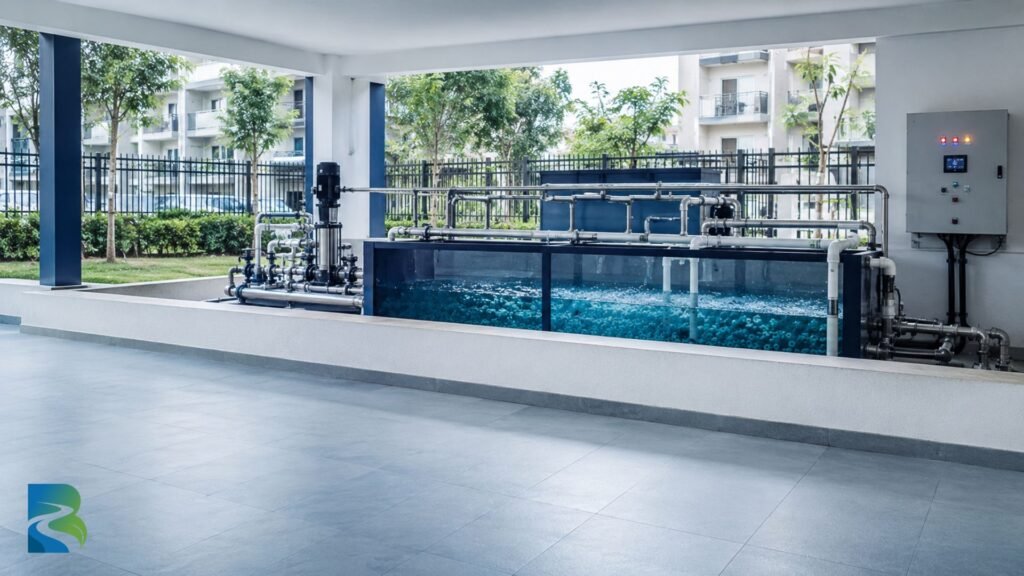
Why Housing Societies Across Maharashtra Are Ditching Conventional STPs for MBBR-Based Systems
Housing societies across Maharashtra are switching from conventional Sewage Treatment Plants to MBBR-based STP systems because MBBR technology lowers running costs, needs far less space, and demands much less manual attention. For a managing committee juggling tight budgets and even tighter plot sizes, solving three problems with one upgrade is hard to ignore. Societies that spent years topping up chemicals, coordinating operator shifts, and fielding odor complaints from residents are now moving to biological, automated treatment instead. This is not a passing trend. It reflects a real shift in how societies evaluate a utility that most residents never think about, until it fails.
What Is an MBBR-Based STP and How Is It Different From a Conventional STP?
An MBBR-based STP treats sewage using bacteria that grow on floating plastic media suspended inside the aeration tank, instead of relying only on free-floating sludge like a conventional Activated Sludge Process (ASP) plant. Because the media provides a much larger surface area for bacteria to colonize, an MBBR tank can treat the same sewage load in a smaller volume. Conventional ASP plants, in contrast, need larger tanks, frequent sludge wasting, and closer manual monitoring to keep the biological process stable. That difference in design is the reason MBBR-based STPs use less power, occupy less land, and tolerate load swings, such as a wedding function or a festival weekend, more gracefully.
Why Are Housing Societies Across Maharashtra Switching to MBBR-Based STPs?
Most societies do not switch on a whim. They switch after living with the same recurring problems for years. The common triggers include:
- Rising diesel, chemical, and operator costs on an aging ASP or SBR plant
- Persistent odor complaints from residents near the STP room
- An STP built for a fixed number of flats now serving far more, with no room to expand the tank
- Frequent breakdowns and AMC visits that never seem to end
- A managing committee that wants IoT-based monitoring instead of a logbook
Across the societies we work with, the pattern looks familiar. A 10 to 15 year old ASP-based STP, built for a certain occupancy, is now serving many more units after later construction phases were added. Sludge handling has become a weekly chore instead of a monthly one, and odor complaints spike every monsoon. Switching to a BIO-DRUM MBBR retrofit inside the same tank resolves the capacity mismatch without new civil work, which is usually the detail that gets committee approval.
How Much Does MBBR Technology Actually Save on STP Operating Costs?
MBBR-based STPs, particularly ones using patented BIO-DRUM MBBR technology, can cut operating costs by up to 80% compared to a conventional plant of the same capacity. This saving comes mainly from optimized aeration. Submerged jet aerators and better oxygen transfer efficiency mean the blowers run less, and that shows up directly on the society’s electricity bill. However, the exact saving depends on the plant’s current condition, sewage load, and how well the existing system was designed in the first place. A society running an old, oversized plant at partial load will usually see a bigger jump than one running a well-maintained, correctly sized plant.
How Much Space Does an MBBR-Based STP Save Compared to a Conventional Plant?
An MBBR-based retrofit typically needs 50 to 60% less space than a conventional STP designed for the same capacity. This matters most to societies that built their STP years ago and now need more capacity without any spare land to build on. Because MBBR media can often be added inside the existing tank structure, a society can upgrade its treatment capacity without breaking ground for new civil work. That single point, no major construction, is usually what convinces a hesitant managing committee to approve the budget.
Does an MBBR-Based STP Meet Pollution Control Board Norms?
Yes. We design every BIO-DRUM MBBR system to consistently deliver treated water with BOD below 10 mg/L, COD below 50 mg/L, and TSS below 10 mg/L, well within the range societies typically need for Pollution Control Board compliance and for safe reuse in gardening, flushing, or cooling applications. Specific discharge limits and consent conditions vary by location, so societies should always confirm current norms with their local board, such as the Maharashtra Pollution Control Board, rather than relying on a blog post for exact numbers.
What Should a Housing Society Check Before Upgrading to an MBBR-Based STP?
A good upgrade decision starts with an honest audit, not a sales pitch. Before signing off, a committee should check:
- Actual occupancy versus the STP’s original design capacity
- Condition of the existing tank, and whether it can be retrofitted or needs rebuilding
- Whether the site needs IoT or SCADA monitoring for remote alerts
- The vendor’s track record on similarly sized societies, not just industrial clients
- What the AMC includes, and how quickly the vendor responds to a breakdown
Brivith Engineering has delivered over 1,000 projects across residential, commercial, and industrial sites, and retrofit work is among our most requested services, precisely because societies want more capacity without construction. For a related look at how automation reduces compliance risk on treatment plants, read our guide on automated ETP compliance.
Summary
MBBR-based STP systems are replacing conventional plants in Maharashtra’s housing societies because they cost less to run, take up less space, and need less manual intervention. Savings of up to 80% on operating cost and 50 to 60% on footprint are achievable, though actual results depend on the site’s current condition and load. Retrofits can often happen inside the existing tank, avoiding new construction. We design treated water quality to stay well within Pollution Control Board norms, though societies should confirm current limits with their local board. Before upgrading, a society should audit real occupancy, tank condition, and vendor track record rather than capacity on paper alone.
Frequently Asked Questions
Is MBBR technology suitable for a small housing society, or only large complexes? MBBR technology scales down as easily as it scales up. Brivith’s STP range starts at 5 KLD, which covers small societies, and goes up to 5,000 KLD or more for large townships, so size alone is not a barrier.
Can an existing conventional STP be converted to MBBR without rebuilding the tank? In most cases, yes. Because MBBR media can be introduced into the existing aeration tank, retrofits are one of the most common upgrade paths for societies with limited space, though a site visit is needed to confirm the tank’s structural fit.
How long does an MBBR-based STP retrofit usually take? A retrofit typically takes a few weeks from design finalization to commissioning, since it avoids major civil work. Timelines vary based on plant size, site access, and whether any structural repair is needed first.
Does an MBBR-based STP need more electricity than a conventional plant? No, it generally needs less. Optimized aeration is the main reason MBBR-based plants use less power than a conventional ASP or SBR plant of the same capacity.
Is treated water from an MBBR-based STP safe to reuse? Yes, we design treated water for non-potable reuse such as gardening, flushing, and cooling tower makeup, subject to the specific application and local guidelines.
What is the typical payback period for switching to MBBR-based STP? Payback period depends on the society’s current operating cost, sewage load, and the specific retrofit scope, so it is best calculated through a site-specific water audit rather than a general estimate.
If You Save Water, Water Will Save You.