Swimming Pool Filtration System: How It Keeps Water Clear and Safe
Crystal-Clear Water. Safe Swimming. Engineered to Last.
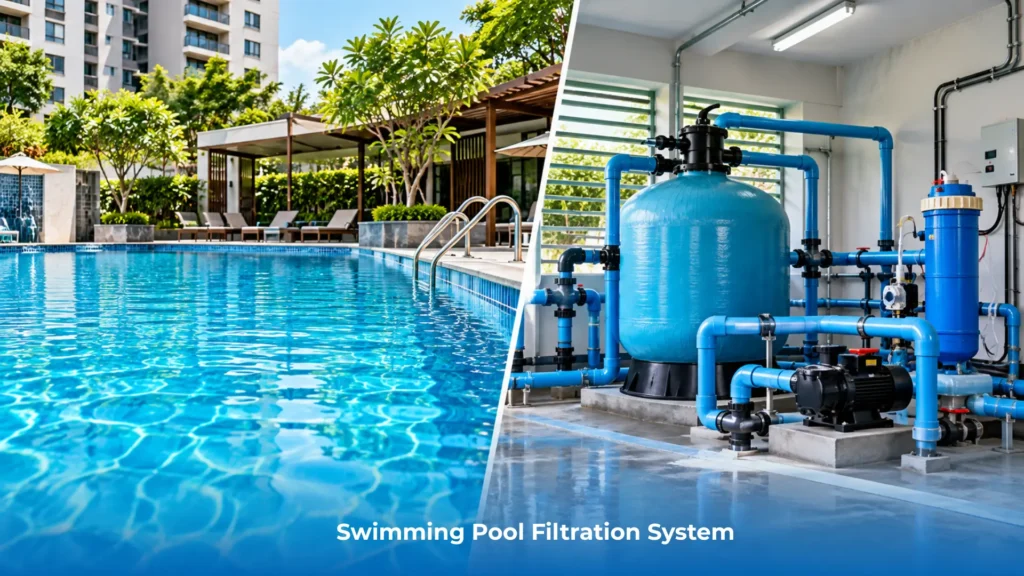
A swimming pool filtration system continuously circulates pool water through filters and disinfection so it stays clear, hygienic and safe to swim in. Without it, even a new pool turns cloudy and unsafe within days.
Brivith Engineering delivers turnkey swimming pool and filtration systems for pools from 10 m³ to 5000 m³, serving residences, hotels and clubs. This guide explains the components, how filtration works, how to size it and how to keep it running well.
What is a swimming pool filtration system?
A swimming pool filtration system is the plant room equipment that pulls water out of the pool, cleans it and returns it. It typically includes skimmers or overflow channels, a strainer, a circulation pump, a sand filter and a disinfection unit.
Together, these components remove dirt, hair, body oils and fine particles, while disinfection controls bacteria. Consequently, the pool stays clear and hygienic even with heavy daily use.
How does a swimming pool filtration system work?
A swimming pool filtration system works as a continuous loop between the pool and the plant room. For example, the six steps below show the typical path water follows.
Periodically, the operator backwashes the sand filter by reversing the flow. This flushes trapped dirt to drain and, as a result, restores filter performance.
What are the main components of a pool filtration plant?
The main components of a pool filtration plant each handle one job in the treatment loop. In short, the table below summarises their roles.
| Component | Role |
|---|---|
| Skimmers or overflow channel | Remove floating debris and surface oils |
| Main drain | Draws water from the pool floor for circulation |
| Strainer | Protects the pump from hair, leaves and debris |
| Circulation pump | Maintains the designed flow rate through the loop |
| Pressure sand filter | Removes fine suspended particles |
| Dosing system | Adds disinfectant and balances pH |
| Heater (optional) | Maintains comfortable water temperature |
| Return inlets | Distribute treated water evenly |
How do you size a swimming pool filtration system?
You size a swimming pool filtration system around the turnover period, which is the time it takes to pass the full pool volume through the filter once. For instance, busy public pools need shorter turnover than lightly used private pools.
Turnover (hours) = pool volume (m³) / filtration flow rate (m³/h). For example, a 200 m³ pool with a 40 m³/h system turns over every 5 hours. This is an illustration only. Your engineer sets the actual design based on pool use, bather load and applicable guidelines.
Other sizing factors include pool shape, depth, whether it is indoor or outdoor, and whether it uses skimmers or an overflow channel. Therefore, every Brivith pool system is designed for the specific pool, not picked from a standard chart.
Which water quality parameters should you monitor?
You should monitor disinfectant level, pH, clarity and combined chlorine as a minimum. Above all, these parameters decide whether the water is safe and comfortable for swimmers.
- Free chlorine confirms enough disinfectant is available to control microbes.
- pH affects both disinfection efficiency and swimmer comfort.
- Clarity shows whether filtration is keeping up with bather load.
- Combined chlorine indicates whether contaminants are building up.
For target ranges and good operating practice, refer to the WHO Guidelines for Safe Recreational Water Environments and any local regulations that apply to your facility.
Who needs a professional swimming pool filtration system?
Any pool with regular users needs a professionally designed filtration system. Specifically, Brivith serves these segments.
Residential Societies
Community pools that serve many families daily.
Hotels and Resorts
Guest-facing pools where clarity reflects your brand.
Clubs and Sports Centres
High bather loads that need robust filtration.
Private Villas
Low-maintenance systems for home pools.
Schools and Institutions
Training pools that must stay safe for students.
Builders and Developers
Turnkey pools delivered with the project.
How do you maintain a swimming pool filtration system?
You maintain a swimming pool filtration system through simple daily, weekly and periodic routines. In fact, a consistent schedule prevents most water quality problems.
| Frequency | Key Tasks |
|---|---|
| Daily | Test chlorine and pH, empty skimmer baskets, check pump operation |
| Weekly | Clean the strainer, backwash the filter as needed, vacuum the pool floor |
| Monthly | Inspect dosing equipment, check valves and gauges |
| Periodically | Inspect filter media condition and service the pump |
Under a Brivith AMC, our team handles these checks and keeps records, so your staff can focus on daily operations.
Why choose Brivith for your swimming pool system?
Brivith brings 25+ years of water treatment engineering to pool design, so filtration, hydraulics and disinfection work as one system.
- Turnkey delivery covering design, supply, installation and commissioning.
- Pools from 10 m³ to 5000 m³ for residences, hotels and clubs.
- Correct hydraulics so every part of the pool gets circulation.
- Automation options for dosing and monitoring.
- Dedicated AMC support for long-term water quality.
Key Takeaways
- A swimming pool filtration system circulates, filters and disinfects pool water continuously.
- Core components include skimmers, a strainer, a pump, a sand filter and a dosing system.
- Sizing is based on turnover period, pool use and bather load.
- Daily testing and regular backwashing keep water clear and safe.
- Explore our pool solutions on the Products page.
Frequently Asked Questions
What is the cost of a swimming pool filtration system?
The cost depends on pool volume, turnover design, filter type, disinfection method and automation. A small villa pool system costs far less than a large club or hotel system. Brivith quotes after reviewing your pool drawings.
How often should a pool sand filter be backwashed?
Backwash frequency depends on bather load and filter pressure. Most operators backwash when the pressure gauge rises above its clean reading by the amount the manufacturer specifies.
Why does my pool water turn green or cloudy?
Green or cloudy water usually points to low disinfectant, poor pH control or inadequate filtration. Check chlorine and pH first, then confirm the pump and filter are running for the designed hours.
Can an existing pool filtration system be upgraded?
Yes. Brivith can audit an existing pool plant and recommend upgrades such as a larger filter, a better pump, automated dosing or improved return inlets.
Should a pool filtration system run 24 hours a day?
Running time depends on the turnover design and pool use. Busy commercial pools often circulate continuously, while private pools may run on a timed schedule set by the designer.
What is the difference between a skimmer pool and an overflow pool?
A skimmer pool draws surface water through openings in the pool wall. An overflow pool lets water spill into a channel around the edge, which typically gives better surface cleaning for busy pools.
Planning a new pool or fixing an old one?
Share your pool size and usage. Our engineers will design a filtration system with the right turnover, filtration and disinfection for crystal-clear water.
Protect Every Drop. Make Industries Water Positive.