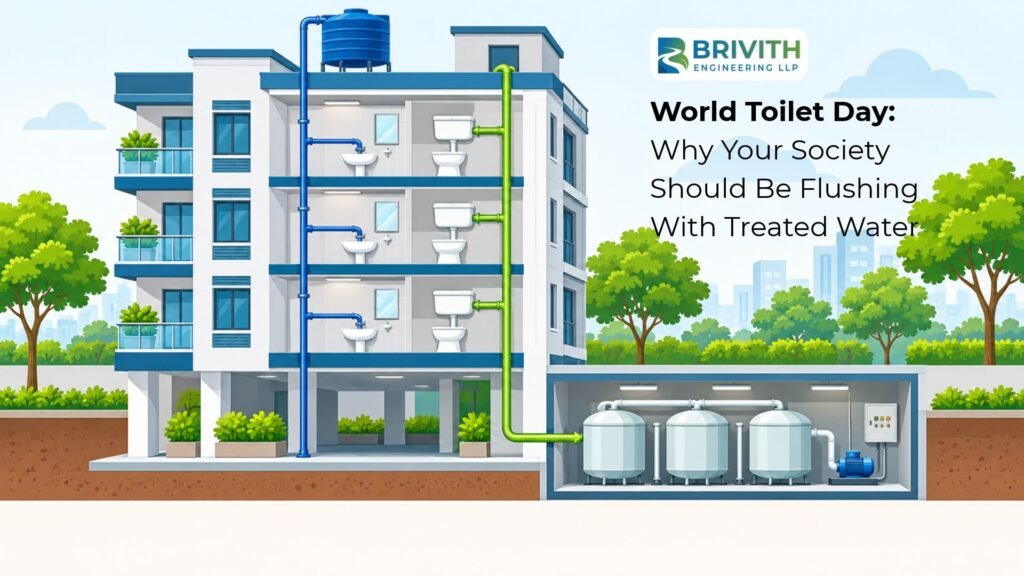
A working sewage treatment plant lets your society flush its toilets with treated water instead of drinking water. That single change protects a large share of the building’s fresh water supply, because Indian plumbing code IS 1172 sets aside 45 litres per person per day purely for flushing.
World Toilet Day falls on 19 November every year. It is therefore a good day for a managing committee to ask one plain question: does our STP actually run, and does its treated water for flushing reach every toilet in the building?
In Pune, that question now carries a cost. Both PMC and PCMC have started acting against societies whose plants sit idle, and the action includes cutting the water connection.
What is the main purpose of an STP?
The main purpose of an STP is to treat the sewage a building generates so that the water can be reused safely instead of wasted. Inside a housing society, the plant collects wastewater from toilets, bathrooms and kitchens. It then breaks down the organic load biologically, settles the solids, and filters and disinfects whatever remains. The output is clear, odour-free water that suits every non-drinking use on the premises.
Reuse, not disposal, is the real objective. Under PMC’s building regulations, residential projects with more than 100 apartments must install their own STP and reuse the treated water on site. Therefore a plant that treats sewage and then pushes it straight into the municipal drain has delivered only half of what it was built for.
Brivith builds society plants on patented BIO-DRUM MBBR technology, which keeps the biological stage compact and the running cost low. Actual performance always depends on site conditions, incoming load and how well the plant is operated.
How important is an STP for a housing society?
Important enough that Pune’s civic bodies now cut water connections over it. In May 2026, PCMC disconnected the water supply of 24 housing societies for failing to operate their STPs, and it served notices on 16 more. A year earlier the same body had warned 184 societies, out of the 456 that fall under its mandatory STP category.
PMC has moved in the same direction. In March 2026 it cleared a plan to mandate monitoring sensors on STPs in societies with more than 100 flats, covering close to 750 private plants across the city. PMC has also announced fines of up to ₹10,000 for drinking water wastage.
Three things therefore ride on your plant:
- Compliance. Notices, penalties and water disconnection all follow a dead STP.
- Cost. Every litre you flush with treated water is a litre of municipal or tanker water your society does not buy.
- The river. Sewage that leaves a society only partly treated adds to the load on the Mula and the Mutha.
How much of your society’s water goes into flushing?
Roughly a fifth to a third of domestic demand, going by code. IS 1172, the Indian standard that the National Building Code refers to for water supply requirements, recommends 150 to 200 litres per person per day for communities above one lakh population with a full flushing system. Out of that figure, it allots 45 litres per person per day to flushing alone.
| Reference point | Code figure |
|---|---|
| Domestic supply, communities above 1 lakh with full flushing | 150 to 200 litres per person per day (IS 1172) |
| Share earmarked for flushing | 45 litres per person per day (IS 1172) |
| Design norm, cities with piped supply and sewerage | 135 litres per person per day (CPHEEO) |
Now put that into society arithmetic. A 200-flat building with four residents per flat holds about 800 people, so flushing accounts for roughly 36,000 litres a day, or close to 10.8 lakh litres a month. Consequently, every month the STP stays off, your society buys that volume as fresh water instead of producing it on site. Occupancy, fixture type and metering all shift the real number, so treat this as a planning reference rather than a measured figure for your premises.
What is dual plumbing, and how does treated water reach your flush tanks?
Dual plumbing is a second, separate pipe network that carries treated water from the STP back to flush tanks, garden taps and washing points. Without it, treated water has nowhere useful to go. The operator then opens the drain valve, and the plant becomes an expensive formality.
A retrofit in an occupied building is usually possible, although it needs planning. Most societies work through four steps:
- Add treated water storage. Typically an underground sump plus an overhead tank, kept physically separate from the potable tank.
- Run a dedicated riser. Existing service shafts often have room for a second line, floor by floor.
- Colour-code and label everything. Every treated water pipe, valve and tap needs clear non-potable marking.
- Rule out cross connections. Have a licensed plumber certify that no treated line touches the drinking water line anywhere.
Where a full riser is genuinely impossible, societies usually start with gardening, common-area washing and basement or podium wash-down. That alone absorbs a useful share of the plant’s output. Because feasibility depends on your shaft layout, get the building’s plumbing drawings checked before you budget for the work.
How do you check whether your society’s STP is actually working?
Look at the water, the logbook and the power bill, in that order. A plant can run on paper and still fail in practice. These seven checks take one walk-through with the operator:
- Outlet water. Treated water should look clear and smell neutral. Cloudiness or a sewage odour points to a biology or filtration problem.
- Reuse flow. Ask where the treated water goes, then ask for the meter reading. If nobody can answer, the plant is treating and dumping.
- Lab reports. Request the latest third-party results for BOD, COD, TSS and pH, then read them against the conditions in your pollution control board consent.
- Aeration. Blowers should run on schedule, and the aeration tank should bubble evenly. Dead patches usually mean choked diffusers.
- Sludge handling. Excess sludge needs regular removal. Otherwise solids carry over into the treated water.
- Operator log. A plant with no daily record of running hours, chemical dosing and meter readings runs on memory alone.
- Power trend. A sudden fall in the STP’s energy consumption often means somebody switches the plant off at night.
If three or more checks fail, your society needs a proper plant audit rather than another repair call.
Why does committee awareness decide whether treated water for flushing ever happens?
Because the STP has no champion unless the committee appoints one. Most society plants fail for reasons that have very little to do with technology.
- The handover gap. Builders are expected to maintain the STP for the first couple of years after handover. However, housing society federations in Pimpri Chinchwad have publicly complained that this rarely holds in practice, which leaves committees with a plant nobody has explained to them.
- No O&M line in the budget. Power, chemicals, operator time and sludge disposal cost money every month. A society that skips this line item will eventually switch the plant off.
- No single owner. One trained committee member plus one accountable operator or AMC vendor works far better than shared responsibility.
- Resident doubts. Treated flush water sometimes carries a faint tint or smell, so residents assume the worst. A short notice-board explainer, with the latest lab report pinned beside it, settles most objections.
The scale of this gap shows up in reuse numbers. A Pimpri Chinchwad housing society federation has cited a 50% treated-water reuse target while claiming that actual reuse sits closer to 30%.
What can your society do this World Toilet Day?
Pick one action from this list and put it on the next committee agenda. The UN theme for World Toilet Day 2026 is Safe toilets. Equal futures., which focuses on sanitation and gender equality, because 3.4 billion people still live without safely managed sanitation.
- Walk the plant with the operator and run the seven checks above.
- Pull out the last three lab reports and your consent conditions, then read them side by side.
- Confirm where the treated water actually goes, and meter it.
- Approve an annual O&M budget line, separate from the general repair fund.
- Put up a one-page notice telling residents why the flush line carries treated water.
- Run a capacity check, because many society plants are either oversized for current occupancy or starved of load. Our STP capacity calculator gives you a first estimate in a minute.
Key takeaways
- The main purpose of an STP is reuse, not disposal, so a plant that treats sewage and then drains it has done only half its job.
- IS 1172 allots 45 litres per person per day to flushing, which makes treated water for flushing the single largest reuse opportunity in any residential building.
- Pune’s civic bodies now enforce this actively, through notices, sensors, penalties and water disconnection.
- Treated water cannot reach your toilets without dual plumbing, so budget for the pipework alongside the plant itself.
- Seven simple checks tell a committee whether its STP genuinely works, and most failures turn out to be management failures rather than technical ones.
Does your society flush with treated water? Yes or No in the comments.
Frequently asked questions
What is the main purpose of an STP in a housing society?
The main purpose is to treat the society’s sewage on site so the water can be reused for non-drinking needs. Flushing, gardening and common-area cleaning are the standard uses. Safe discharge of whatever is not reused is the secondary purpose.
Is treated water safe to use for flushing?
Yes, provided the plant runs properly and the treated water meets the quality your consent conditions specify. Treated water is not drinking water, so it must travel in a clearly labelled, separate pipe network with no cross connection to the potable line. Periodic third-party testing of BOD, COD, TSS and pH gives a committee its proof of safety.
Is an STP mandatory for housing societies in Pune?
For larger projects, yes. PMC’s building regulations require residential projects with more than 100 apartments to install an STP and reuse the treated water on site, while PCMC applies the requirement to complexes above 20,000 square metres of built-up area. Thresholds and rules do change, so confirm the current requirement with your corporation or an engineer before you plan any work.
How much water can a society save by flushing with treated water?
The ceiling depends on how much of your demand goes into flushing, which IS 1172 puts at 45 litres per person per day. For an 800-resident society, that works out to roughly 36,000 litres a day. Real savings then depend on occupancy, how much of the plant’s output your plumbing can deliver, and how reliably the plant runs.
Can an existing building add dual plumbing for treated water?
Usually yes, through a retrofit. The work involves a separate treated-water tank, a dedicated riser in the service shaft, labelled pipework and a certified check for cross connections. Where a full riser is not feasible, societies start with gardening and common-area washing, then extend the network later.
What does it cost to run a society STP every month?
The recurring heads are power, chemicals, operator wages, sludge disposal and the AMC. Total cost varies with plant capacity, the technology installed and the actual incoming load, so a figure quoted by another society is a poor guide. Ask for an estimate built on your own plant’s design flow and current occupancy.
Need a second opinion on your society’s plant?
Our team will review your STP, its reuse setup and its running cost, and tell you plainly what it needs.
Request a Free Consultationsales@brivith.com · +91 98600 88545 · Hadapsar, Pune
Sources
- IS 1172, Code of Basic Requirements for Water Supply, Drainage and Sanitation (flushing allowance of 45 litres per person per day).
- CPHEEO Manual on Water Supply and Treatment, Ministry of Housing and Urban Affairs (135 litres per person per day service level).
- UN-Water, World Toilet Day 2026 campaign: Safe toilets. Equal futures.
- Press reports on PMC and PCMC enforcement action against housing societies with non-functional STPs, 2025 to 2026.