
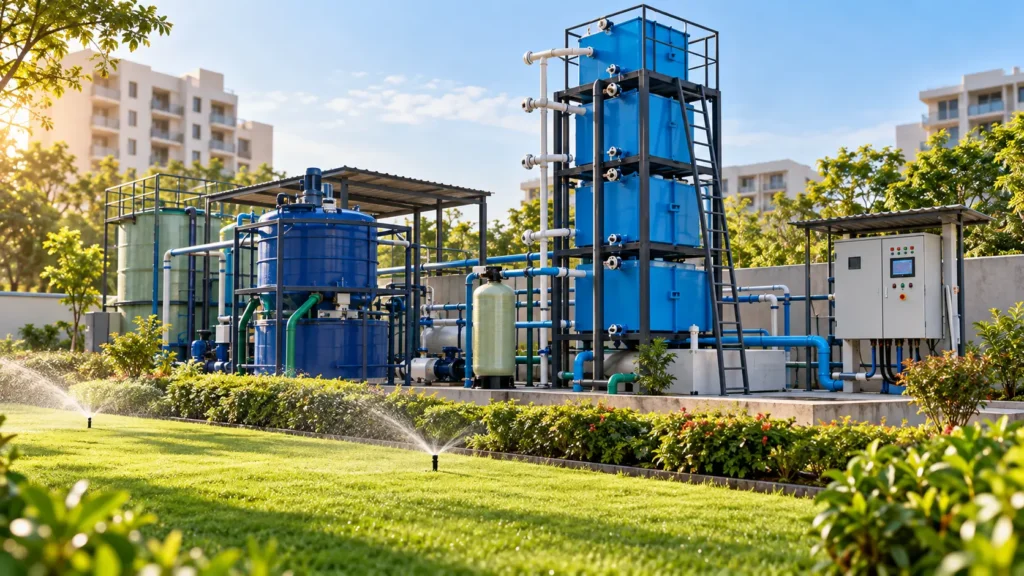
Brivith Engineering LLP designs, manufactures and installs BIO-DRUM MBBR sewage treatment plants for housing societies, hotels, commercial buildings and campuses in Pune. We help you size the plant around actual sewage flow, plan for treated-water reuse and compare installation and operating costs.
What is a BIO-DRUM MBBR sewage treatment plant?
A sewage treatment plant treats domestic wastewater from toilets, bathrooms and kitchens. In a Moving Bed Biofilm Reactor (MBBR), microorganisms grow on carrier media and break down organic matter. BIO-DRUM MBBR is Brivith’s configuration of this biological treatment process. Reactor sizing, aeration and downstream treatment depend on the incoming sewage and the quality required at the outlet.
A typical treatment train includes screening, flow equalisation, biological treatment, solids separation, filtration and disinfection. It also needs a plan for sludge handling. Configuration and water quality targets are set for each project.
Above-ground, underground, terrace and containerised layouts can be evaluated against the available space, structure and service access. Define the tank material, aeration and controls during design. Discuss PLC controls and any SCADA or remote monitoring requirements before the quote is finalised.
Depending on the treatment provided and site requirements, treated sewage can be used for non-potable applications such as toilet flushing and landscaping. Cooling tower make-up requires a separate check of water quality and equipment requirements.
STP design, manufacturing, installation and service
- Site assessment and design. Review sewage sources, average and peak flows, the available plant room or plot, access for maintenance, and the intended reuse or discharge route.
- Manufacture, installation and commissioning. Define tank configuration, treatment equipment, piping, control panels, civil work interfaces, and the tests needed at handover.
- Existing STP upgrades and maintenance. Assess whether existing tanks and equipment can be reused. Agree the scope of servicing, monitoring and operator support through Brivith’s plant maintenance and AMC services.
How do you size an STP for a housing society?
Start with the estimated volume of sewage reaching the plant each day, then check peak hourly flow and how occupancy can change over time. STP capacity is expressed in kilolitres per day (KLD). For a new society, use expected occupancy and water usage. For a retrofit, share flow records, any recent water-quality tests and existing plant drawings.
For a preliminary estimate
Gather the number of flats and expected occupancy, daily water consumption, measured sewage flow if available, space and access constraints, and planned uses for treated water. Use the STP capacity calculator to get a starting estimate for engineering review.
What affects STP plant cost in Pune?
The cost depends on capacity, the condition of any existing tanks, civil work, treatment and disinfection requirements, and the scope of installation. Ask for an itemised quote that states its design assumptions and where the site contractor’s work begins.
- Installation costs. Compare tanks and civil work, equipment, electrical and piping interfaces, controls, commissioning and handover tests.
- Operating costs. Ask about power and aeration, operator visits, consumables, sludge handling and maintenance coverage.
- Reuse costs. Include treated-water storage, pumping and any separate distribution needed for flushing or landscaping.
For sites planning both reuse and monsoon runoff management, see Brivith’s rainwater harvesting systems.
Frequently asked questions
What size STP does my housing society need?
Capacity depends on daily sewage flow, peak flow and occupancy. Start with the number of flats and water-use data, then have an engineer review the estimate and site constraints.
What does an MBBR STP cost in Pune?
Request a site-specific quote covering capacity, civil works, equipment, controls, installation and commissioning. Compare ongoing power, consumables, sludge handling and service as well as the initial price.
Can Brivith upgrade an existing STP?
Brivith can assess the existing plant and identify tanks or equipment that may be reusable. Flow measurements, drawings and recent test results help determine whether a retrofit is practical.
Can treated STP water be reused for flushing and landscaping?
These are possible non-potable uses when the treatment, storage and distribution are designed for them and the treated water meets applicable requirements. Check the intended uses during plant design and verify water quality during operation.
How can an STP design address odour?
Review how incoming sewage is stored, how the biological stage is aerated, and how sludge is handled. Enclosure and ventilation may also be needed, especially near occupied areas. Include operating and maintenance requirements in the design review.
What should I send for a project quote?
Share the site location, property type, number of flats or occupants, any measured flows, available space or drawings, and the intended reuse or discharge. Mention whether the project is a new installation or an upgrade.
Get a quote for your STP project
Send your project details to Brivith. An engineer can review your capacity estimate, equipment scope and options for installation or retrofit.
Protect Every Drop. Make Industries Water Positive.
Hi, this is a comment.
To get started with moderating, editing, and deleting comments, please visit the Comments screen in the dashboard.
Commenter avatars come from Gravatar.