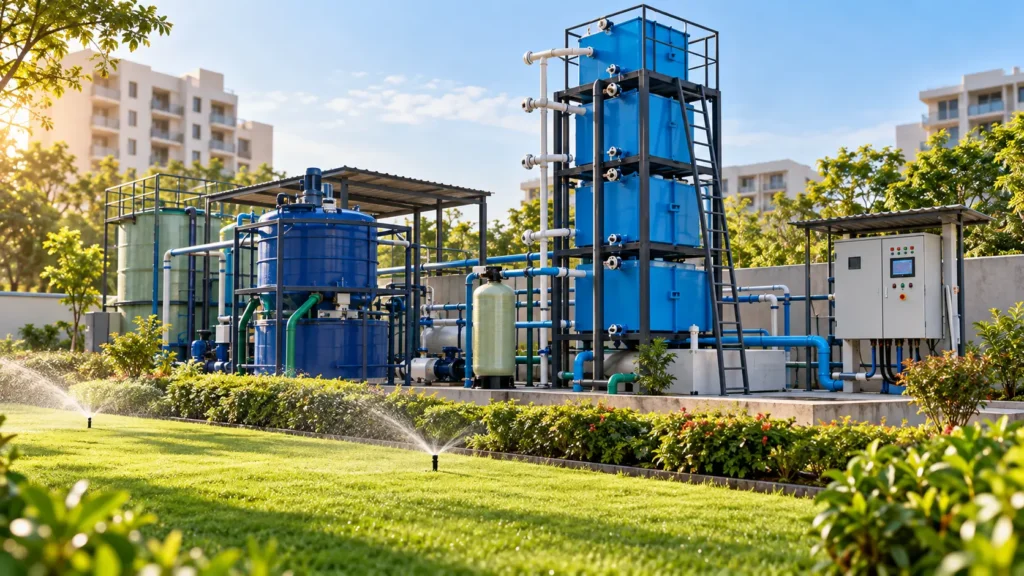
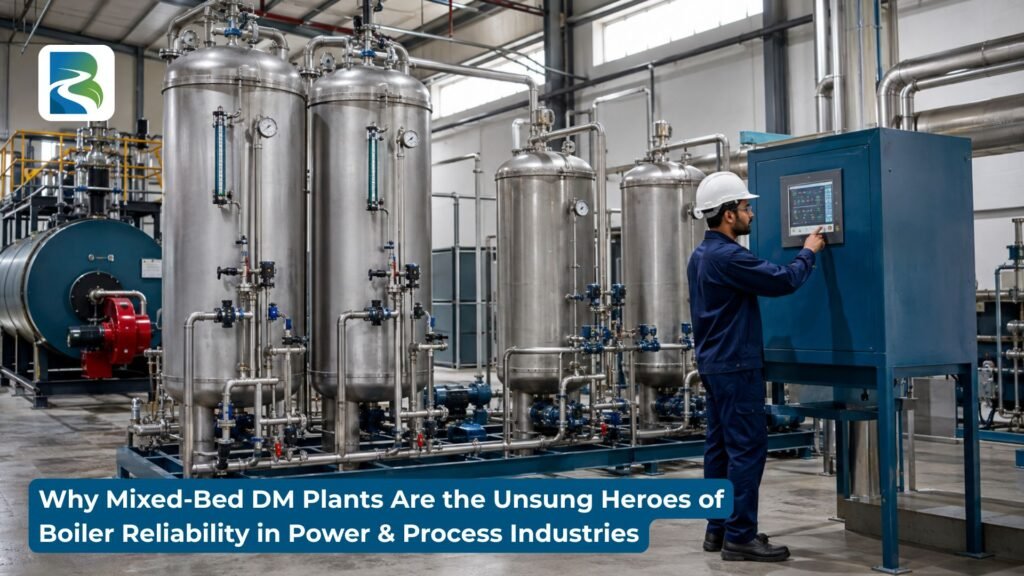
“What is the cost of an industrial RO plant?” is one of the first questions plant heads and procurement teams ask us. The honest answer is that industrial RO plant cost in India depends on your raw water, not on a catalogue. For example, two plants with the same 5,000 LPH label can differ widely in price. One may treat hard borewell water, while the other treats clean municipal supply. In this guide, we explain the seven factors that decide the price, the RO types that suit different industries, and how to judge a vendor before you sign a purchase order.
What is the cost of an industrial RO plant in India?
There is no single price for an industrial RO plant, because the cost depends on seven design inputs. These are capacity, feed water TDS, recovery target, membrane type, skid material, automation level and pretreatment. So a vendor who quotes a fixed rate before seeing your water analysis is guessing. That guess usually shows up later as fouled membranes, high reject volume or extra power bills.
For this reason, Brivith does not publish a price list. Instead, we size every plant from a raw water report. Then we share a proposal that explains what each rupee pays for. Brivith designs industrial RO plants from 250 LPH to 5,00,000 LPH and above, so the range of possible designs is wide.
What decides industrial RO plant cost?
Seven factors decide the price of an industrial RO plant. Some affect the purchase price, while others affect what you pay every month to run the plant. The sections below explain each factor in plain terms.
1. Capacity (LPH): how much water do you really need?
Capacity is the first cost driver, because it sets the number of membranes, pressure vessels, pump size and skid size. However, bigger is not always safer. An oversized plant costs more upfront and can run poorly at part load. On the other hand, an undersized plant runs longer hours and wears out faster.
To size capacity correctly, work out your peak hourly demand, daily operating hours and planned expansion. For instance, a site that needs 40,000 litres per day could choose a 2,000 LPH plant running 20 hours. It could also choose a 4,000 LPH plant running 10 hours. Each choice changes the price.
2. Feed water TDS: what is in your raw water?
Feed water TDS (Total Dissolved Solids) decides the operating pressure, membrane choice and pump rating. Higher TDS needs higher pressure. In turn, higher pressure means a bigger high-pressure pump and more power per litre. Brivith RO plants typically operate between 8 and 25 kg/cm², depending on feed TDS.
TDS is only one line of the report, though. Hardness, silica, iron, manganese, turbidity and organic load also matter, because they decide how fast membranes foul or scale. Therefore, a full raw water analysis is the starting point of any honest quotation. A TDS meter reading alone is not enough.
3. Recovery target: how much reject can you afford?
Recovery is the share of feed water that comes out as treated water (permeate). Depending on water quality, Brivith RO plants achieve 50% to 85% recovery. Higher recovery saves water and cuts reject disposal. However, it needs more careful design.
As recovery rises, salts concentrate in the reject stream and scaling risk grows. Consequently, a high-recovery plant may need extra stages, better antiscalant dosing and tighter monitoring. This adds cost upfront. Still, it can pay back where water is expensive or reject disposal is a compliance concern.
4. Membrane type: which membrane suits your water?
Membranes are the heart of the plant, so membrane choice affects both price and performance. Industrial RO plants commonly use thin film composite (TFC) polyamide membranes in a few broad grades:
- Standard brackish water membranes for typical borewell and municipal water.
- Low energy membranes that run at lower pressure, which helps cut power cost on low to moderate TDS water.
- High rejection membranes for uses that need tighter permeate quality, such as boiler feed or process water.
- Fouling-resistant membranes for feed water with higher organic or suspended load.
Also, ask your vendor for a membrane projection report. Membrane makers provide design software for this, such as DuPont’s WAVE PRO modelling tool. The report shows the expected permeate quality, pressure and recovery for your exact water. If a vendor cannot share one, they have not really designed your plant.
5. Skid material: MS, SS304 or SS316?
The skid (frame) and piping material affect price, service life and fit for your industry. The table below compares the three common options.
| Skid material | Typical use | Cost position | What to check |
|---|---|---|---|
| MS powder coated | General industrial and utility water in dry plant rooms | Lowest | Coating quality; corrosion risk in humid or chemical areas |
| SS304 | Food, beverage, hotels, hospitals and cleaner plant rooms | Medium | Weld finish and grade certificates |
| SS316 | Pharma, high-chloride water and corrosive settings | Highest | Material test certificates; fit for hygiene-critical lines |
In short, choose the material your site and audit rules need, not simply the most expensive one.
6. Automation: manual, semi-automatic or PLC/SCADA/IoT?
Automation adds cost, but it cuts operator dependency and protects membranes. Brivith offers four levels:
- Manual: lowest price, but it needs a trained operator on every shift.
- Semi-automatic: auto start and stop on tank levels, with basic protection switches.
- Fully automatic PLC/SCADA: auto flushing, trip protection and data logging.
- IoT remote monitoring: real-time alerts on pressure, flow and TDS, so problems show up before the membranes suffer.
For 24×7 plants or sites with frequent operator changes, automation can cost less than the membrane damage it prevents.
7. Pretreatment: the part most quotations underplay
Pretreatment protects membranes, and it is where low quotations usually cut corners. A typical industrial pretreatment train can include:
- Raw water pump with dosing, such as a coagulant, where needed.
- Pressure sand or multimedia filter to remove suspended solids.
- Activated carbon filter or SMBS dosing to remove chlorine, which damages polyamide membranes.
- Softener, if hardness is high.
- Antiscalant dosing to control scaling.
- Micron cartridge filter just before the high-pressure pump.
Not every plant needs every step, because your water analysis decides the train. However, a plant quoted without enough pretreatment for hard, iron-rich or turbid water will likely need frequent membrane cleaning and early replacement.
Quick reference: industrial RO cost drivers
| Cost driver | What it changes | Question to ask your vendor |
|---|---|---|
| Capacity (LPH) | Membranes, vessels, pump and skid size | What peak demand and operating hours did you size for? |
| Feed water TDS | Pressure, pump rating and power use | Which water analysis is this design based on? |
| Recovery target | Stages, antiscalant and reject volume | What recovery do you guarantee, and at what feed quality? |
| Membrane type | Permeate quality, pressure and power | Can I see the membrane projection report? |
| Skid material | Corrosion life and hygiene compliance | Which grade, and will you share material certificates? |
| Automation | Operator load and membrane protection | Which trips and alarms are included? |
| Pretreatment | Fouling, cleaning frequency and membrane life | Why is each step included or left out? |
Why is the purchase price only part of the RO plant cost?
The purchase price is only the entry ticket, because running costs continue every month for the life of the plant. Over several years, these costs can add up to more than the plant itself. Lifecycle cost includes:
- Power: the high-pressure pump runs every operating hour, so pressure and pump efficiency matter.
- Membrane replacement: membrane life depends on feed water, pretreatment and maintenance.
- Chemicals: antiscalant, cleaning chemicals and pretreatment dosing.
- Consumables: cartridge filters, filter media and carbon.
- Reject water handling: disposal, reuse or further treatment of the concentrate.
- Downtime: every hour the plant stops can stall production downstream.
Therefore, compare quotations on total cost of ownership over at least five years. Ask each vendor to state expected power use, membrane life assumptions and consumable costs in writing.
Which type of RO plant is good for your industry?
The right type of RO depends on your feed water and the purity your process needs. Here is how the main types compare.
| RO type | Best suited for | Typical industries |
|---|---|---|
| Single-pass brackish water RO | Borewell or municipal water for general process and utility use | Automobile, textile, hotels, cooling tower makeup |
| Double-pass RO | Uses that need lower permeate TDS than a single pass can give | Pharma, boiler feed, specialty process water |
| RO with mixed bed or EDI polishing | Very high purity water | Pharma purified water, high-pressure boiler feed |
| High-recovery RO | Water-scarce sites or high water cost | Dairy, chemical, ZLD-focused plants |
| Seawater RO | Seawater or very high TDS feed | Coastal industries |
That said, RO is not always the answer. If hardness is your only problem, a water softener plant may solve it at a lower cost. A good consultant will tell you that before selling you an RO.
Which industrial RO plant is the best in India?
The best industrial RO plant in India is the one designed for your raw water, your recovery target and your process. No single brand is best for every site. For example, a well-known brand built on the wrong design will still foul. Meanwhile, a properly engineered plant from a capable local firm can run reliably for years.
Instead of chasing a brand, look for these signs of a well-designed plant:
- Design based on a full water analysis, not a TDS reading.
- A membrane projection report that matches your water.
- Pretreatment sized for your actual feed quality.
- Named makes and models for membranes, pumps, vessels and instruments.
- Clear operation manuals, drawings and test reports.
- A service team close enough to respond quickly.
How do you evaluate an industrial RO plant vendor?
Evaluate vendors on design discipline and service, not just price. Use this five-step checklist:
- Water analysis first. A serious vendor asks for, or arranges, a lab report before quoting.
- Recovery design. Ask what recovery they guarantee and how they will control scaling at that level.
- Membrane and component quality. Ask for the make and model of every major part, plus the projection report.
- Pretreatment logic. Ask why each step is included. Good vendors explain every choice against your water report.
- AMC and service. Check what the annual maintenance contract covers: visit frequency, membrane cleaning, consumables, response time and spares.
Also, ask for references from similar industries and, where possible, visit a running plant.
What red flags should you watch for in RO quotations?
Some quotations look cheap only because key items are missing. Watch for these warning signs:
- A price quoted over the phone without any water analysis.
- Recovery promised without a stated feed water basis.
- Membrane or pump make written as “reputed make” with no model number.
- Pretreatment reduced to a single cartridge filter for hard or turbid water.
- No mention of reject water handling.
- AMC terms that exclude most consumables and visits.
Each of these can turn a cheaper quotation into the more expensive plant over time.
What should you share to get an accurate RO proposal?
Share these details, and a good vendor can size your plant properly:
- A recent raw water analysis report covering TDS, hardness, alkalinity, chlorides, sulphates, silica, iron, manganese, turbidity and pH, plus organics where relevant.
- Treated water needed per day and peak hourly demand.
- Treated water quality your process requires.
- Water source: borewell, municipal, tanker or recycled.
- Available space, power supply and preferred automation level.
- Your plan to handle or reuse reject water.
At Brivith, our engineers use this data to recommend capacity, recovery, membranes, skid material, automation and pretreatment, with the reason behind each choice. Meanwhile, you can explore our free water treatment tools for related sizing.
Summary: how to buy an industrial RO plant without overpaying
- Industrial RO plant cost depends on seven factors: capacity, feed TDS, recovery, membrane type, skid material, automation and pretreatment.
- A full water analysis must come before any quotation.
- Compare total cost of ownership, not just the purchase price.
- The best RO plant is the one designed for your water and your process.
- Choose vendors who share projection reports, explain pretreatment and offer clear AMC terms.
Get a sized RO proposal from Brivith. Send your raw water report to sales@brivith.com or WhatsApp +91 98600 88545. You can also book a free consultation with our engineers.
Frequently asked questions
What is the cost of a commercial RO plant in India?
The cost of a commercial or industrial RO plant depends on capacity, feed water quality, recovery target, membrane type, skid material, automation and pretreatment. Because these vary from site to site, a reliable quotation needs a raw water analysis first. Compare quotations on five-year running cost, not just the purchase price.
Which type of RO is good for industrial use?
For most industries, a single-pass brackish water RO with proper pretreatment works well. Pharma and high-pressure boiler applications often need double-pass RO or RO with mixed bed or EDI polishing. Water-scarce sites should consider a high-recovery RO design.
How long do industrial RO membranes last?
Membrane life depends on feed water quality, pretreatment, cleaning practice and operating discipline. With good pretreatment and regular maintenance, membranes often last 3 to 5 years, although actual life varies by site. Poor pretreatment is the most common reason membranes fail early.
What recovery should an industrial RO plant achieve?
Brivith RO plants achieve 50% to 85% recovery, depending on water quality. Higher recovery saves water but raises scaling risk, so it needs better antiscalant dosing and monitoring. Your water analysis decides the safe recovery limit.
Is an SS316 skid necessary for an RO plant?
An SS316 skid is necessary only where hygiene rules or corrosion demand it, such as in pharma or high-chloride settings. SS304 suits food, beverage and hospitality plants. MS powder-coated skids work well for general utility water in dry plant rooms.
What information do I need to get an RO plant quotation?
You need a recent raw water analysis, daily and peak treated water demand, required water quality and your water source. Space, power supply and reject handling plans also help. With this data, a vendor can size the plant accurately instead of guessing.