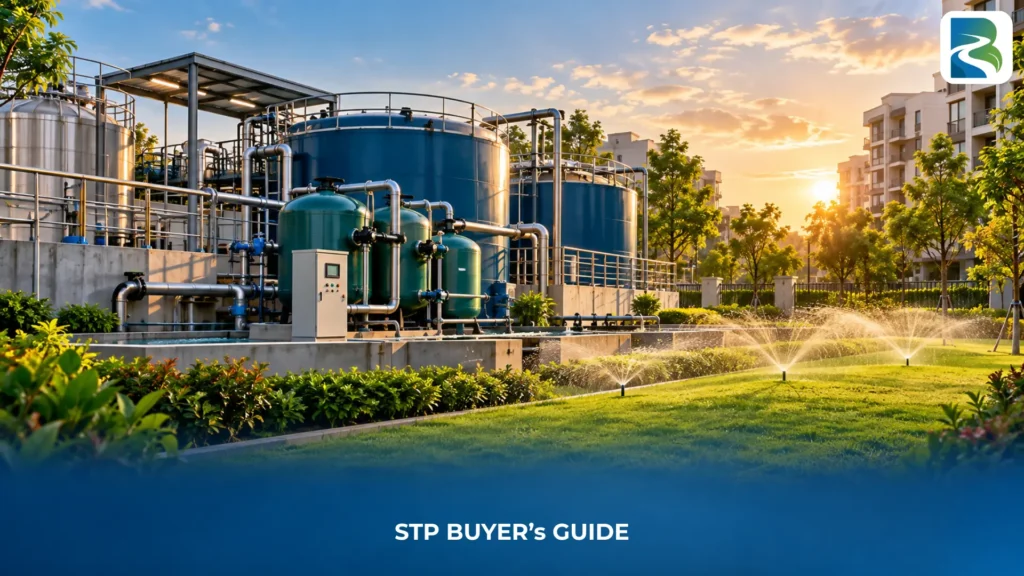
Cost, space, MPCB, power, AMC and more. Straight answers before you sign.
Written by the water treatment engineers at Brivith Engineering LLP, Pune.
Installing an STP plant is a long-term decision, so most buyers ask the same 11 questions before they sign. They want to know the cost, the space, the power bill, and who takes responsibility when something goes wrong. This guide answers each question plainly, based on how Brivith Engineering designs, builds and maintains sewage treatment plants for housing societies, builders, hotels, hospitals and industries across Maharashtra.
Where the answer depends on your site, we say so. More importantly, we tell you exactly which details decide it, so you can compare any supplier’s quote with confidence.
How a Brivith STP treats sewage (typical process flow)
Before the questions, here is the big picture. Sewage passes through a series of stages, and each stage removes a different type of pollutant. Most importantly, the heart of the system is the BIO-DRUM MBBR reactor, where bacteria growing on moving media break down organic matter.
1. How much does it cost to install an STP plant?
STP plant cost depends mainly on capacity (KLD), technology, construction material, installation location and automation level. Two STP plants of the same capacity can differ widely in scope, so an accurate price needs your daily sewage flow, site layout and reuse plan. Share these on WhatsApp and Brivith will send you an indicative estimate.
Simply put, there is no honest “per KLD” price for an STP plant that fits every project. For example, a terrace-mounted FRP plant for a small society and an underground RCC plant for an industrial campus involve completely different materials, civil work and controls. These seven factors decide your final number:
However, the purchase price is only half the story. After all, you will pay for power, operators and maintenance every single day the plant runs. Therefore, always compare quotes on lifecycle cost, not just the capital figure.
- Number of flats, occupants or your daily water consumption
- Available area and where the plant can go (underground, terrace, open ground)
- Details of any existing STP on site
- How you want to reuse the treated water
2. How much space does an STP plant need?
Space depends on capacity and technology. Brivith’s patented BIO-DRUM MBBR design needs up to 50 to 60% less space than conventional STPs, depending on site conditions. It can go underground, above ground, on a terrace or inside a container.
MBBR saves space because bacteria grow on thousands of small media carriers inside the reactor. As a result, each cubic metre of tank does far more treatment work than an open conventional tank. That is why BIO-DRUM MBBR suits crowded urban plots and projects that want to keep open areas free.
For tight sites, however, you have three practical options for placing the STP plant. First, an underground plant can sit below landscaping or a driveway. Second, a terrace installation uses roof space that is often idle. Third, a containerized plant arrives as a compact unit and needs minimal civil work. During the site survey, our team confirms the exact footprint for your capacity.
3. Will MPCB compliance be handled?
Yes. Brivith designs every STP to meet the treated water norms that apply to your project and provides the technical details you need for consent applications. BIO-DRUM MBBR plants are designed to deliver BOD below 10 mg/L, COD below 50 mg/L and TSS below 10 mg/L, subject to inlet conditions and correct operation.
For instance, here are the treated water design targets for a Brivith STP plant:
| Parameter | What it measures | Brivith BIO-DRUM MBBR design output |
|---|---|---|
| BOD | Organic load that consumes oxygen | Below 10 mg/L |
| COD | Total chemically oxidisable pollutants | Below 50 mg/L |
| TSS | Suspended solids in the water | Below 10 mg/L |
| Odor | Smell around the plant | Odor-free closed aeration |
Design values. Actual results depend on inlet sewage quality, flow and operation and maintenance.
However, one point matters here. MPCB issues consent to the project owner, so the application stays in your name. Brivith supports it with the plant design, process description and expected performance data. Because discharge norms can vary by location and consent conditions, always check the latest requirements on the Maharashtra Pollution Control Board website or with your consultant.
4. What happens if the STP plant fails?
Most STP problems build up gradually from overloading, skipped maintenance or equipment wear, rather than happening overnight. Brivith reduces this risk with a shock-load-resistant BIO-DRUM MBBR design, automation that flags faults early, optional IoT alerts and AMC support for quick repair.
In an MBBR plant, bacteria live on media carriers instead of floating freely. Consequently, the biology copes better with sudden changes in sewage quantity and quality, such as a festival weekend or a monsoon spike. When a fault does occur, this is how the response works:
- Early warning: PLC automation and optional IoT monitoring flag abnormal readings or equipment trips.
- Diagnosis: The AMC team checks the plant remotely or on site to find the cause.
- Repair: Our engineers replace or repair the faulty pump, blower or component.
- Root cause fix: We correct the underlying issue, for example overloading or an operating error, so it does not repeat.
Does the design include standby pumps and blowers for critical equipment? What response time does the AMC contract commit to? Clear answers here protect you far more than a low quote.
5. How much electricity will the STP consume?
Aeration uses most of an STP’s electricity. Brivith’s BIO-DRUM MBBR uses optimised aeration with submerged jet aerators, which cuts running cost by up to 80% compared with conventional systems. Actual consumption depends on capacity, sewage load and operating hours.
Bacteria need oxygen to digest sewage, so blowers typically run around the clock. Conventional plants, however, can push more air than the process needs, and that wasted air shows up on your electricity bill every month. In contrast, BIO-DRUM MBBR delivers oxygen efficiently, which lowers power demand and keeps noise close to zero.
When you compare proposals, ask each supplier for the connected load (kW) and the estimated daily running hours. With those two figures, you can calculate the real monthly power cost yourself. Need help with the numbers? Ask for a running cost estimate on WhatsApp.
BIO-DRUM MBBR vs conventional STP at a glance
| Factor | Brivith BIO-DRUM MBBR | Conventional STP |
|---|---|---|
| Running cost | Up to 80% lower* | Higher aeration power |
| Space needed | 50 to 60% less* | Larger tanks |
| Odor | Odor-free closed aeration | Open tanks can cause smell |
| Noise | Near-zero (submerged jet aerators) | Surface equipment can be noisy |
| Operator dependency | Very low, highly automated | Needs more manual attention |
| Shock loads | Resistant | Can upset the process |
*Site-condition dependent. Figures compare against conventional STP designs.
6. How much will STP AMC cost?
AMC cost depends on plant capacity, technology, contract type (comprehensive or non-comprehensive), whether an operator is included and how often engineers visit. Because BIO-DRUM MBBR needs very little operator input and minimal chemicals, maintenance effort is usually lower than for conventional plants. Ask for a tailored AMC quote on WhatsApp.
In general, most STP plant AMC contracts fall into two types. The right choice depends on your budget and how much risk you want to hand over.
| What is covered | Non-comprehensive AMC | Comprehensive AMC |
|---|---|---|
| Scheduled service visits | Included | Included |
| Breakdown attendance | Included | Included |
| Spare parts | Billed separately | Included (as per contract) |
| Best for | Owners with in-house technical staff | Owners who want predictable annual cost |
You can also add a trained operator to either contract. Brivith offers dedicated AMC support for the plants it installs.
7. Can I reuse the treated water from my STP?
Yes. Treated water from a Brivith STP suits non-potable uses such as toilet flushing, gardening, landscaping and cooling tower makeup. It is not meant for drinking. Reuse cuts your freshwater demand and lowers water bills.
Reuse also supports green building certifications and ESG goals. However, if your process needs higher purity water, treated water can go through further polishing. Our guide on high-recovery RO technology for water reuse explains how that works.
8. Can you retrofit my existing STP plant?
Yes, in most cases. BIO-DRUM MBBR technology is retrofit-friendly, so Brivith can often upgrade an existing STP’s capacity or treated water quality using your existing tanks, without major civil work. A site audit confirms feasibility.
A retrofit makes sense when your current plant shows any of these signs:
- Constant odor or noise complaints from residents or staff
- Electricity bills for the STP that keep climbing
- Treated water that fails to meet discharge or reuse norms
- More occupants or production than the plant was designed for
- Frequent breakdowns and rising repair spend
First, we audit your current STP plant and its sewage quality. Next, we design the upgrade around your existing structure. Finally, we plan the installation to limit disruption to daily operations.
9. How quickly can you install an STP plant?
The timeline depends on capacity, installation type and civil work. Packaged FRP or containerized units usually install faster than plants that need new RCC tanks, and retrofits skip much of the civil stage. Brivith shares a project schedule with the proposal after the site survey.
In practice, every Brivith STP plant project moves through the same six stages:
- Site survey and water auditWe measure flow, test sewage and study the site.
- Design and approvalYou review the layout, specifications and proposal.
- Manufacturing and civil workEquipment gets built while the site is prepared.
- InstallationOur team installs tanks, media, pumps, blowers and controls.
- Commissioning and testingWe start the biology and check treated water quality.
- Training and handoverYour team learns daily operation before we hand over.
In addition, an STP plant project moves fastest when civil readiness, site access and internal approvals are sorted early. So, involve us at the planning stage rather than after construction ends.
10. Who will maintain the STP plant?
Brivith can maintain it under an AMC, or train your team to run it. Every project includes training and handover, and high automation means the plant needs very little daily operator input. Optional IoT monitoring lets our engineers track performance remotely.
| Task | Who handles it |
|---|---|
| Daily checks and logbook entries | Your trained staff or an AMC operator |
| Scheduled servicing of pumps and blowers | Brivith AMC team |
| Treated water quality checks | Brivith AMC team |
| Breakdown repairs and spares | Brivith AMC team (as per contract) |
| Remote performance tracking | Brivith, via optional IoT and SCADA |
Low operator dependency matters because many STP plants struggle when a trained operator leaves. As a result, automation keeps your plant running consistently even when staff change.
11. Can you guarantee the STP output quality?
Brivith designs every STP to meet specified treated water parameters and checks performance at commissioning. For BIO-DRUM MBBR, the design targets are BOD below 10 mg/L, COD below 50 mg/L and TSS below 10 mg/L. Any honest guarantee depends on inlet sewage staying within design limits and correct operation and maintenance.
Therefore, be cautious of any supplier who promises STP plant output quality without first asking about your sewage. A genuine commitment always links to three things:
- Inlet characteristics: the flow and pollutant load the plant was designed for.
- Operation: the plant runs as per the operating manual and training.
- Maintenance: servicing happens on schedule, ideally under an AMC.
When all three hold, a well-designed plant delivers consistent results. That is exactly why Brivith starts every project with a water audit instead of a price list. To see our full specifications, visit the Brivith Sewage Treatment Plant page.
Key takeaways before installing an STP plant
- STP cost depends on capacity, technology, material, location and automation, so compare quotes on lifecycle cost, not just price.
- BIO-DRUM MBBR needs up to 50 to 60% less space and cuts running cost by up to 80% versus conventional systems (site dependent).
- Brivith designs for BOD below 10 mg/L, COD below 50 mg/L and TSS below 10 mg/L, and supports your MPCB consent with technical data.
- Treated water suits flushing, gardening and cooling towers, and existing plants can often be retrofitted without major civil work.
- Output quality depends on design, inlet load, operation and maintenance, which is why an AMC and a proper water audit matter.
Frequently asked questions about STP plants
What is an STP plant?
An STP (sewage treatment plant) removes organic matter, suspended solids, odor and harmful microorganisms from domestic wastewater. The treated water can then be safely discharged or reused for non-potable purposes such as flushing and gardening.
What is the difference between an STP and an ETP?
An STP treats domestic sewage from toilets, kitchens and bathrooms. An ETP (effluent treatment plant) treats industrial wastewater that contains chemicals, oils or process pollutants. Many factories need both. Read more in our article on automated ETPs for pharma and chemical plants.
What is MBBR technology in an STP?
MBBR (Moving Bed Biofilm Reactor) uses small plastic carriers that move freely in the aeration tank. Bacteria grow as a biofilm on these carriers and digest organic pollutants. Because the carriers hold a lot of biology in a small volume, MBBR plants are compact and handle load changes well.
Is an STP mandatory for housing societies in Maharashtra?
Many new residential and commercial projects above a certain size need an STP under environmental and building approval conditions. The exact threshold depends on project size and the planning authority. Therefore, confirm the requirement with your local authority or MPCB, and Brivith can guide you on sizing.
What capacity STP does my building need?
STP capacity is based on your daily water consumption, because most water used in a building returns as sewage. Occupancy, building type and future expansion also matter. Brivith sizes plants from 5 KLD to 5000 KLD and above after a site assessment.
Can STP treated water be used for drinking?
No. STP treated water is meant for non-potable uses such as flushing, gardening, landscaping and cooling towers. Drinking water needs separate treatment and must meet potable water standards.
Planning an STP or upgrading an old one?
Talk to a Brivith engineer about cost, space and compliance for your site. Free consultation, no obligation.
Protect Every Drop. Make Industries Water Positive.