
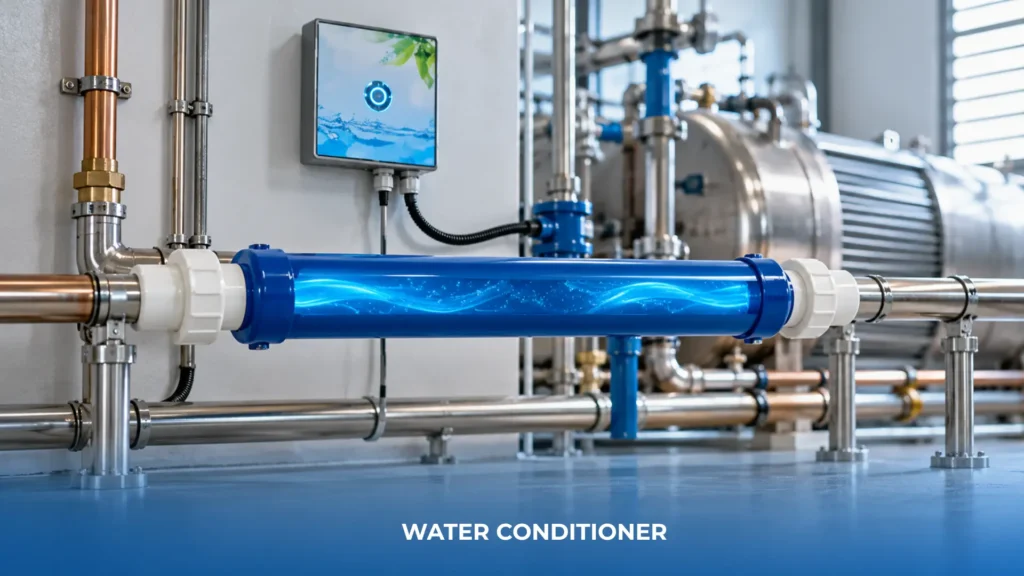
Water Conditioner System: Salt-Free Scale Control That Lasts
No Salt. No Chemicals. No Maintenance. Smart Water Conditioning.
A water conditioner system reduces the harmful effects of hard water without salt, chemicals or regeneration. Instead of removing hardness minerals, it changes how they crystallise, so they are less likely to form hard scale on pipes and equipment.
The Brivith Water Conditioner fits inline on existing pipelines, needs no maintenance and offers a product life of up to 25 years. This guide explains how it works, where it fits best and how it compares with a conventional softener.
What is a water conditioner system?
A water conditioner system is an inline device that treats hard water as it flows through the pipe. The Brivith unit uses advanced ionization technology to alter the crystallization behaviour of calcium and magnesium minerals.
Because the minerals stay in the water but form less adherent crystals, they are less likely to build up as hard scale. As a result, pipelines, heat exchangers, boilers and RO systems stay cleaner for longer, without any salt or chemical input.
How does a water conditioner system work?
A water conditioner system works by conditioning water in the pipe rather than removing anything from it. The five steps below explain the process in simple terms.
A water conditioner does not remove hardness or reduce TDS. A lab test will still show the same hardness. What changes is the scaling behaviour of those minerals on surfaces.
What are the specifications of the Brivith water conditioner?
The Brivith water conditioner system is designed for fit-and-forget operation across domestic, commercial and industrial pipelines.
| Specification | Value |
|---|---|
| Technology | Advanced water conditioning / ionization technology |
| Installation type | Inline, fits directly into existing pipelines |
| Maintenance | Maintenance free |
| Salt requirement | No salt required |
| Chemical requirement | No chemicals required |
| Product life | Up to 25 years |
| Warranty | 2-year unconditional guarantee |
| Trial option | 30-day trial available |
Water conditioner vs water softener: what is the difference?
The key difference is that a softener removes hardness, while a water conditioner changes how hardness behaves. Each has a clear role, so the comparison below helps you decide.
| Factor | Water Conditioner | Water Softener |
|---|---|---|
| How it works | Alters crystallization of minerals | Removes Ca and Mg by ion exchange |
| Hardness in treated water | Unchanged | Removed |
| Salt or chemicals | None | Salt for regeneration |
| Water wastage | None | Backwash and rinse water |
| Maintenance | Maintenance free | Salt refills and resin care |
| Best for | Scale control on pipes and heat transfer surfaces | Processes that need chemically soft water |
If your process or boiler maker specifies soft water by a hardness limit, a water softener plant is the right choice. However, if your goal is simply less scale with zero maintenance and zero discharge, a conditioner is often the smarter option. The 30-day trial lets you verify results on your own system.
Where does a water conditioner system work best?
A water conditioner system works best wherever scale on pipes and heat transfer surfaces is the main problem. Typical applications include the following.
| Residential | Commercial | Industrial |
|---|---|---|
| Bungalows and villas | Hotels and hospitals | Boilers and cooling towers |
| Apartments and societies | Educational institutions | Heat exchangers and chillers |
| Residential complexes | Shopping malls | HVAC and RO pretreatment |
| Hot water and solar systems | Commercial buildings | Process equipment |
For background on what water hardness is and why it forms scale, the U.S. Geological Survey offers a clear explainer.
Why choose the Brivith water conditioner system?
The Brivith water conditioner is built for long, trouble-free service with no running cost. These are its key advantages.
No Salt, No Chemicals
Nothing to refill, dose or dispose of.
Ionization Technology
Changes how hardness minerals crystallise.
25-Year Life
Long-term performance with minimal intervention.
2-Year Guarantee
Unconditional guarantee for peace of mind.
30-Day Trial
Evaluate performance before you commit.
Zero Water Waste
No regeneration means no wastewater.
Eco-Friendly
No salt discharge and no chemical use.
Easy Installation
Inline fitting with minimal pipeline changes.
What business benefits does a water conditioner system deliver?
A water conditioner system saves money on energy, maintenance and water at the same time. In practice, users see these benefits.
- Fewer scale deposits on pipelines, boilers and heat transfer equipment.
- Better energy efficiency because clean surfaces transfer heat more effectively.
- Longer equipment life for expensive industrial and commercial assets.
- Lower maintenance cost through less frequent cleaning and downtime.
- No discharge of salt, chemicals or wastewater.
- Water savings, since there is no regeneration cycle.
How do you install a water conditioner system?
You install a water conditioner system inline on the main supply line or just before the equipment you want to protect. The process is quick and simple.
- Share your pipe size, flow rate and application with our team.
- Select the right unit for your line size and water use.
- Fit the unit inline with minimal modification to existing pipework.
- Start the 30-day trial and monitor scaling on your equipment.
- Review results with our engineers and continue with full confidence.
Key Takeaways
- A water conditioner system controls scale by changing how hardness minerals crystallise.
- It uses no salt, no chemicals and no regeneration, so it wastes no water.
- It does not remove hardness, so processes needing chemically soft water should use a softener.
- The Brivith unit offers up to 25 years of life, a 2-year guarantee and a 30-day trial.
- Explore it on our Products page.
Frequently Asked Questions
Does a water conditioner remove hardness from water?
No. A water conditioner does not remove calcium and magnesium, so measured hardness stays the same. It changes how those minerals crystallise, which reduces hard scale formation on surfaces.
Is a water conditioner better than a water softener?
Neither is better in every case. A conditioner suits scale control with zero maintenance and zero discharge. A softener suits processes that need water below a specific hardness limit.
Does a water conditioner need electricity or maintenance?
The Brivith water conditioner is maintenance free and needs no salt, chemicals or regeneration. Confirm the power requirement for your specific model with our team.
How long does a water conditioner last?
The Brivith water conditioner offers a product life of up to 25 years. It also comes with a 2-year unconditional guarantee.
Can I try a water conditioner before buying?
Yes. Brivith offers a 30-day trial so you can evaluate performance on your own system before a long-term commitment.
Can a water conditioner be used for boilers and cooling towers?
Yes, boilers, cooling towers, heat exchangers and chillers are common applications. However, if your boiler maker specifies a feed water hardness limit, you need a softener or DM plant to meet it.
Want scale control without salt or chemicals?
Tell us your pipe size, flow and application. We will recommend the right unit and set up a 30-day trial on your system.
Protect Every Drop. Make Industries Water Positive.