DM Plant: How Demineralization Works and Which Setup You Need
High-Purity Water for Critical Industrial Applications.
A DM plant (demineralization plant) removes almost all dissolved mineral ions from water using ion exchange resins. The result is high-purity water with very low conductivity, suitable for boiler feed, pharma, power plants and sensitive processes.
Brivith Engineering builds DM plants from 250 LPH to 5,00,000 LPH. This guide explains how demineralization works, the common configurations, and how to choose between DM, RO and softened water.
What is a DM plant?
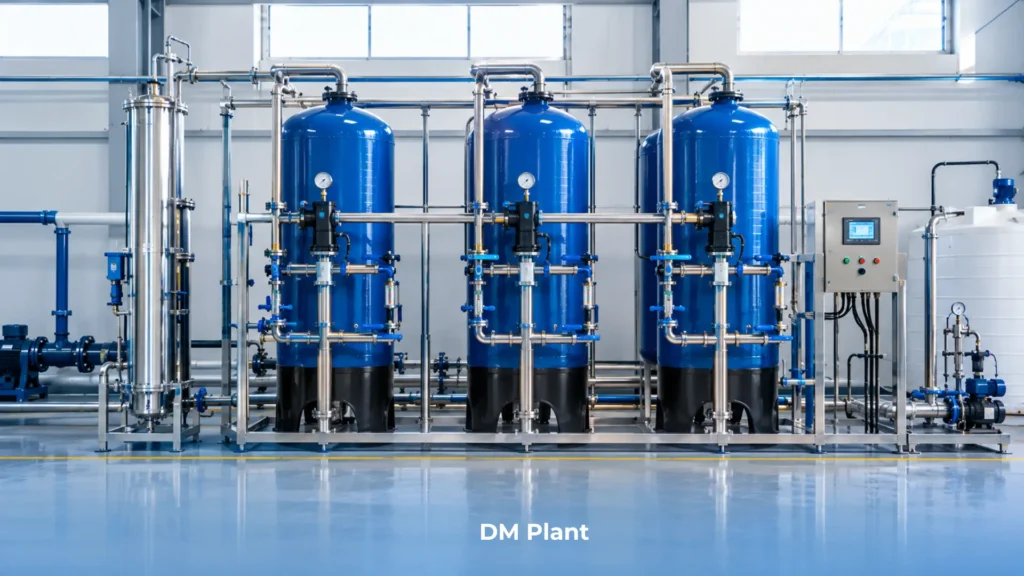
A DM plant is a set of ion exchange vessels that strips both positive and negative ions out of water. A cation resin removes ions such as calcium, magnesium and sodium, while an anion resin removes chlorides, sulphates, nitrates, bicarbonates and silica.
Unlike a softener, which only swaps hardness for sodium, demineralization removes nearly all dissolved salts. That is why it is the standard choice when water quality must be measured in conductivity rather than hardness.
How does a DM plant work?
A DM plant works by passing water through a cation exchanger, a degasser and an anion exchanger in sequence, with an optional mixed bed for final polishing. For example, the flow below shows a typical arrangement.
As a result, the hydrogen and hydroxide ions released by the two resins combine to form pure water. Meanwhile, an online conductivity meter tells the operator when the resins are exhausted and need regeneration.
How do you regenerate a DM plant?
You regenerate a DM plant with acid for the cation resin and caustic for the anion resin. Regeneration restores the resin so it can remove ions again.
- Hydrochloric acid regenerates the cation resin and restores its hydrogen form.
- Caustic soda regenerates the anion resin and restores its hydroxide form.
- Regeneration waste goes to a neutralization pit before discharge.
- Automated regeneration through PLC control also improves safety and consistency.
Acid and caustic handling needs proper storage, dosing systems and operator training. That is why Brivith designs regeneration systems with safe chemical handling and neutralization built in.
Which DM plant configuration do you need?
The DM plant configuration you need depends on raw water quality and the purity your application demands. In practice, these are the four most common setups.
| Configuration | Typically Used When |
|---|---|
| Two-bed (cation + anion) | Moderate purity is enough and raw water TDS is low to medium |
| Two-bed + degasser | Raw water carries high alkalinity, so CO2 removal saves anion resin |
| Two-bed + mixed bed | Very low conductivity and silica are required, such as high-pressure boilers |
| RO + mixed bed | Raw water TDS is high, so RO removes the bulk and the mixed bed polishes |
For high-pressure boilers in particular, mixed-bed polishing is often essential. We explain why in Mixed-Bed DM Plants and Boiler Reliability.
DM plant vs RO plant vs water softener: which one fits?
A DM plant delivers the highest purity, an RO plant removes most dissolved salts, and a softener removes only hardness. Therefore, the right choice depends on what your process can tolerate.
| Factor | DM Plant | RO Plant | Water Softener |
|---|---|---|---|
| What it removes | Nearly all dissolved ions | Most dissolved salts | Hardness only |
| Purity level | Highest | High | Hardness-free, TDS unchanged |
| Consumables | Acid and caustic | Antiscalant, membranes | Salt |
| Typical use | HP boilers, pharma, power | Process, utility, beverages | LP boilers, cooling, laundry |
When raw water TDS is high, an RO plant with high recovery ahead of a mixed bed often cuts acid and caustic consumption significantly compared with DM alone. However, the right split depends on your water analysis.
Which industries use a DM plant?
Industries that cannot tolerate dissolved salts in their water rely on demineralized water. Here are the most common applications.
Boiler Feed Water
Protects high-pressure boilers from scale and silica deposits.
Power Plants
Supplies make-up water for steam cycles and turbines.
Pharmaceuticals
Feeds purified water systems and formulation processes.
Chemicals
Provides consistent water for reactions and dilution.
Electronics and Labs
Delivers low-conductivity rinse and lab water.
Automobile
Supports paint shops and surface finishing lines.
Why choose Brivith for your DM plant?
Brivith engineers each system around your raw water analysis and purity target. Beyond design, we support the plant for its whole life.
- Custom configuration from two-bed to RO plus mixed bed.
- Automated regeneration with PLC, SCADA and IoT monitoring options.
- Safe chemical handling with neutralization built into the design.
- Turnkey delivery covering design, installation, commissioning and AMC.
- 25+ years of expertise across boiler, pharma and process water.
For wider guidance on boiler and utility efficiency, the Bureau of Energy Efficiency publishes useful resources for Indian industry.
How do you size a DM plant?
You size a DM plant from your daily water demand, raw water ion load and the regeneration interval you can accept. To do this, use the checklist below.
- Get a full water analysis, including silica, alkalinity and TDS.
- Define the purity target, usually as conductivity and silica limits.
- Calculate daily demand and the output needed between regenerations.
- Decide on a degasser or RO pre-stage based on alkalinity and TDS.
- Choose automation and chemical handling suited to your team.
Key Takeaways
- A DM plant removes nearly all dissolved ions using cation and anion ion exchange resins.
- Engineers add degassers, mixed-bed polishers or RO pre-stages based on water quality and purity needs.
- Regeneration uses acid and caustic, so safe handling and neutralization are essential.
- Brivith DM plants range from 250 LPH to 5,00,000 LPH for boiler, pharma and power applications.
- Explore the range on our Products page.
Frequently Asked Questions
What is the difference between DM water and RO water?
Ion exchange strips nearly all dissolved ions out of DM water, so its conductivity is very low. RO membranes, on the other hand, remove most but not all dissolved salts. Many plants combine RO with a mixed bed to get the best of both.
What is the price of a DM plant?
DM plant price depends on capacity, raw water quality, configuration, vessel material and automation. Brivith provides a quotation after reviewing your water analysis and purity target.
How often does a DM plant need regeneration?
Regeneration frequency depends on raw water ion load, resin volume and daily output. Brivith sizes the resin beds so regeneration fits your operating schedule.
What is a mixed bed in a DM plant?
A mixed bed is a single vessel containing both cation and anion resins. It polishes water after the main DM or RO stage to achieve very low conductivity and silica.
Is DM water safe to drink?
DM water suits industrial use, not drinking. It lacks minerals and is not treated to potable water standards.
Can a DM plant be automated?
Yes. Brivith offers fully automatic DM plants with PLC-controlled regeneration, online conductivity monitoring and SCADA or IoT connectivity.
Need high-purity water you can rely on?
Send us your raw water analysis and purity target. We will recommend the right DM configuration, with or without RO and mixed-bed polishing.
Protect Every Drop. Make Industries Water Positive.