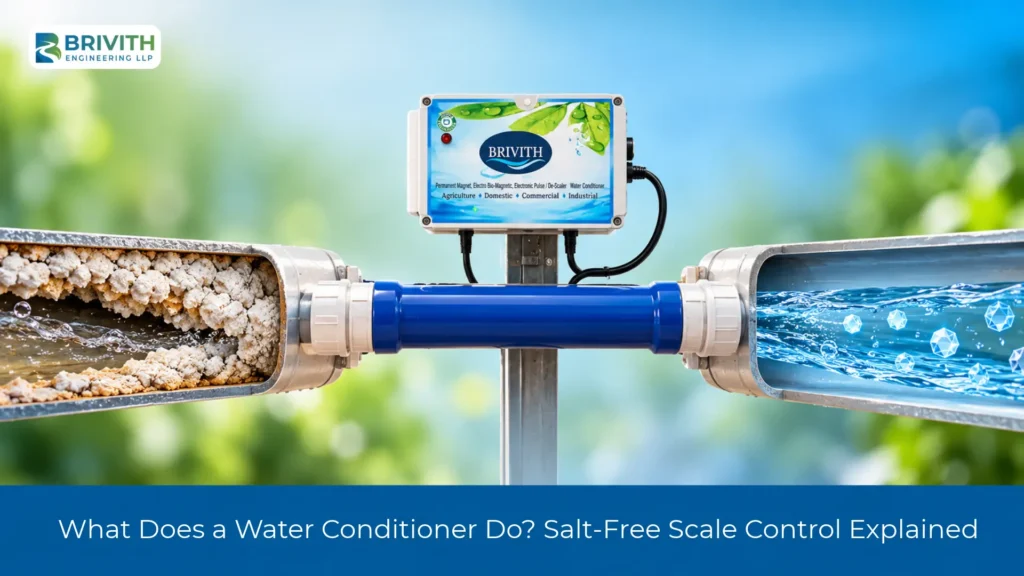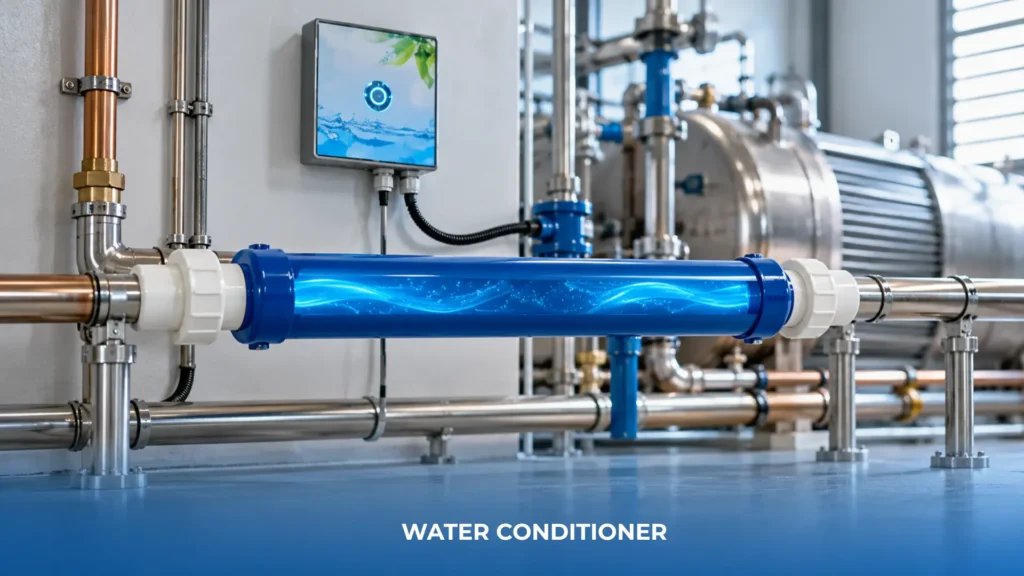
Seeing scale on your geyser, hot-water lines or industrial equipment? Brivith Engineering in Pune helps buyers in India assess whether an inline, salt-free water conditioner fits their application. A conditioner is used to manage scale. It does not remove hardness or lower total dissolved solids (TDS).
Brivith will confirm model suitability, availability and trial terms before installation.
Choosing an inline water conditioner
A water conditioner is fitted in the supply line upstream of the equipment or part of the building you want to protect. The right placement depends on pipe size, peak flow, incoming water quality and the equipment’s water quality requirements.
In homes and housing societies, start with the cold-water feed to a geyser or central hot-water system. For an industrial water conditioner, share operating flow, the water source and which heat exchanger or process line is affected. Where an equipment supplier specifies a hardness limit, select treatment that can meet that limit.
For background, see what a water conditioner does.
Water conditioner vs water softener
| Factor | Salt-free conditioner | Ion-exchange softener |
|---|---|---|
| Purpose | Scale management where the equipment can accept the incoming hardness. | Reduce calcium and magnesium hardness to a target. |
| Hardness | Remains in the water. | Reduced when sized and operated for the duty. |
| TDS | Does not lower TDS. | Exchanges ions and should not be specified for TDS reduction. |
| Salt and service | No salt regeneration. Confirm power and service requirements for the quoted model. | Typically uses salt for resin regeneration and produces rinse water. Plan salt refills and checks. |
See Brivith’s industrial water softener plant if your application calls for lower hardness. For dissolved salts, review industrial RO treatment against your water analysis and outlet specification.
Enquire about a 30-day trial
Tell us what you want to protect. Brivith can review where the unit would fit and agree what to observe during the trial, such as new deposits at a specific inspection point under comparable operating conditions.
Prefer to speak with Brivith? Contact the team or call +91 98600 88545.
Frequently asked questions
Does a water conditioner remove hardness or lower TDS?
No. Calcium and magnesium remain in the water, and the conditioner does not lower TDS. If you have a hardness limit, evaluate a softener. If your concern is dissolved salts, ask about treatment suited to your water analysis.
Can I use a water conditioner for a geyser?
Brivith can assess whether conditioning is suitable on the cold-water feed. Share the pipe size, source and geyser model if known. Check the manufacturer’s water quality and installation requirements before proceeding.
Can an industrial water conditioner replace a softener?
Use a softener where equipment or process specifications require reduced hardness. Consider conditioning where scale management is the goal and the equipment can operate with the incoming hardness.
Does the unit need electricity or maintenance?
Ask Brivith for the power and service requirements of the model quoted for your site. Confirm what needs inspection and who will handle it during and after the trial.
How does the 30-day trial work?
Share your application and site details so Brivith can review suitability and confirm availability, installation arrangements and commercial terms. Agree what to inspect and how to compare results before the trial starts.
Protect Every Drop. Make Industries Water Positive.