
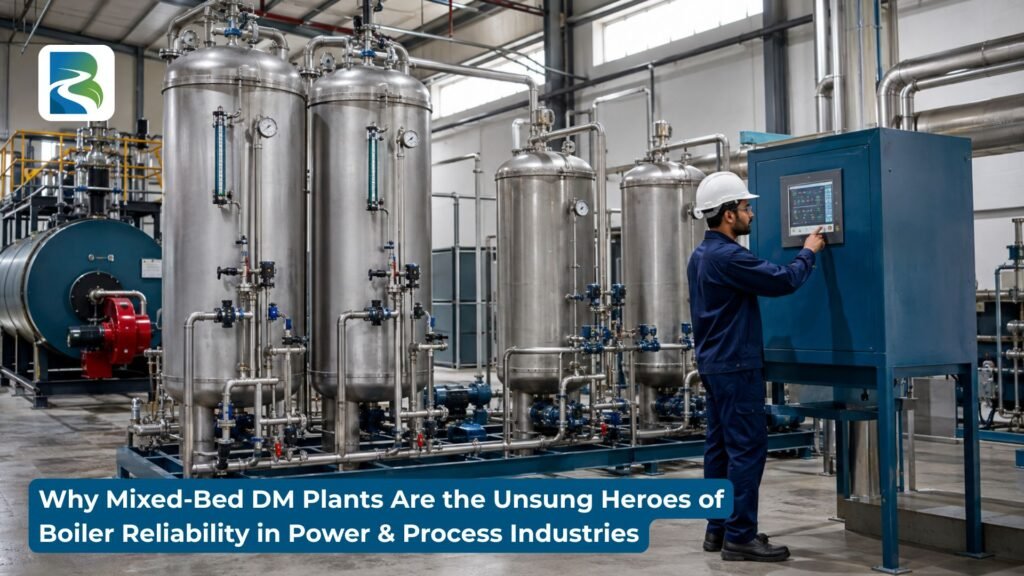
Ask any plant manager what keeps a boiler running reliably, and you’ll hear about burners, pressure gauges, and maintenance schedules. Rarely will you hear about the water going into the boiler. Yet feed water quality is one of the most common — and most overlooked — causes of boiler downtime, tube failure, and rising fuel costs across power and process industries.
This is where the Mixed-Bed Demineralization (DM) Plant quietly does its job, day after day, largely unnoticed until something goes wrong without it.
The Problem: What’s Really in Your Feed Water
Raw water, even after softening or RO treatment, still carries dissolved ions — calcium, magnesium, silica, chlorides, and traces of other minerals. In a boiler operating at high temperature and pressure, these ions don’t stay harmless. They:
- Deposit as scale on heat transfer surfaces, reducing efficiency
- Concentrate and cause corrosion in boiler tubes and drums
- Carry over into steam, damaging turbines in power applications
- Reduce boiler life and increase unplanned shutdown risk
Even trace-level silica, often ignored, can form hard, glassy deposits on turbine blades that are extremely difficult to remove.
What Is a Mixed-Bed DM Plant?
A DM (Demineralization) Plant removes virtually all dissolved ions from water using ion exchange resins — producing water with very low conductivity, suitable for high-pressure boilers.
A mixed-bed DM plant combines both cation and anion exchange resins in a single vessel, rather than separate columns (as in a two-bed system). This gives water multiple contact points with both resin types in one pass, resulting in higher purity output — which is why mixed-bed units are typically used as a polishing stage after a two-bed DM plant, especially for high-pressure and power-industry boilers where feed water purity requirements are strict.
In simple terms: if a two-bed DM plant does the heavy lifting, the mixed-bed unit does the fine polishing — squeezing out the last traces of dissolved ions that a two-bed system may leave behind.
How the Process Works
- Cation Exchange — Removes positively charged ions (calcium, magnesium, sodium) and replaces them with hydrogen ions
- Anion Exchange — Removes negatively charged ions (chlorides, sulphates, silica) and replaces them with hydroxide ions
- Mixed-Bed Polishing — Cation and anion resins work together in one vessel, driving conductivity down further and improving silica removal
- Regeneration — Once resin capacity is exhausted, the bed is regenerated using acid (for cation resin) and caustic soda (for anion resin), restoring exchange capacity
The result is water with very low total dissolved solids (TDS) and low silica content — the two parameters power and process boilers are most sensitive to.
Why This Matters for Boiler Reliability
| Feed Water Issue | Consequence for Boiler |
|---|---|
| Hardness (Ca, Mg) | Scale formation, reduced heat transfer, higher fuel use |
| Dissolved silica | Hard deposits on tubes and turbine blades |
| Chlorides | Localized corrosion and pitting |
| High conductivity | Increased blowdown, water and energy loss |
| Poor purity, generally | More frequent shutdowns for cleaning and descaling |
Boiler manufacturers typically specify feed water quality limits that vary by operating pressure — the higher the pressure, the tighter the tolerance for impurities. Since these limits are boiler- and pressure-specific, we always recommend checking your boiler OEM’s feed water specification alongside a site water analysis before finalizing DM plant design.
DM Plant vs RO Plant vs Water Softener — Where Does It Fit?
Industries considering boiler feed water treatment often ask whether RO, softening, or DM is the right choice. Each plays a different role:
- Water Softener — Removes hardness only; not sufficient for high-pressure boilers on its own
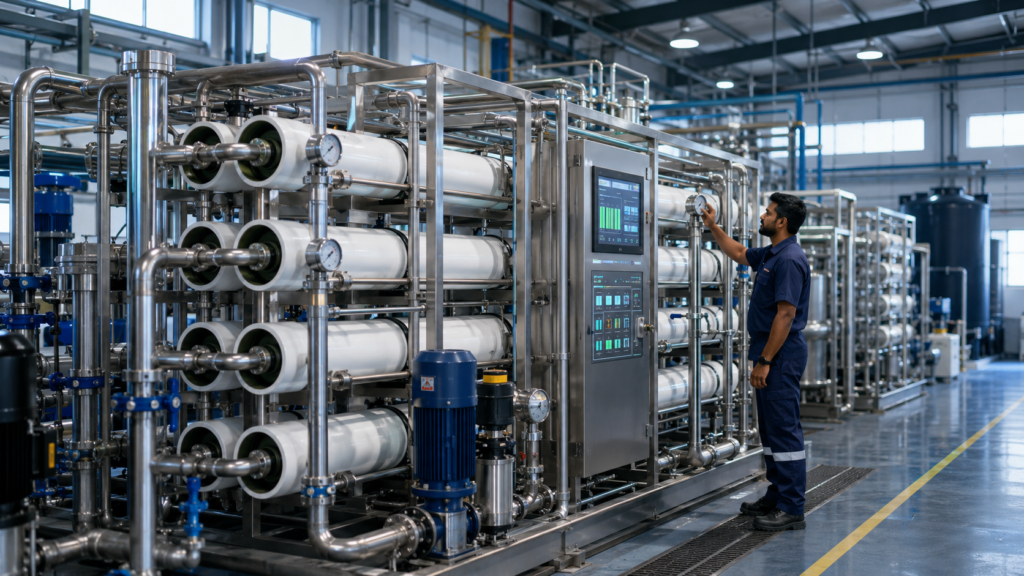
- RO Plant — Removes 90%+ of dissolved salts and is commonly used as a pre-treatment stage ahead of DM, reducing the ionic load the DM resins need to handle
- DM Plant (Two-Bed + Mixed-Bed) — Delivers the near-complete demineralization high-pressure boilers require
In most modern industrial setups, these aren’t competing technologies — they work in sequence: Softener/RO → Two-Bed DM → Mixed-Bed Polisher, each stage reducing the burden on the next.
Selection Considerations for a Mixed-Bed DM Plant
When designing a DM system, several site-specific factors determine plant sizing and configuration:
- Boiler operating pressure — Higher pressure boilers demand stricter feed water purity
- Raw water quality — Higher hardness/TDS at intake increases resin regeneration frequency
- Makeup water volume — Continuous process makeup vs. batch/startup-only requirements
- Capacity — Brivith designs mixed-bed DM systems across a wide capacity range, from smaller process applications to large power-industry requirements, customized to actual water analysis and boiler specification
- Automation level — PLC/SCADA-based regeneration control reduces manual dependency and human error in regeneration timing
Maintenance: What Keeps a DM Plant Reliable
A DM plant is only as good as its upkeep. Key maintenance practices include:
- Regular resin capacity checks to track exchange efficiency over time
- Timely regeneration using correctly dosed acid and caustic, avoiding both under- and over-regeneration
- Conductivity and silica monitoring at the outlet to catch resin exhaustion early
- Resin replacement when fouling or capacity loss becomes irreversible — typically after several years of service, depending on water quality and usage
- Backwashing to prevent resin bed compaction and channeling
Neglecting these steps doesn’t just reduce DM plant performance — it directly increases the risk of the boiler issues described earlier.
The Automation Advantage
Manually tracking resin exhaustion and regeneration timing across shifts is where many DM plants lose reliability — not because the technology fails, but because operational discipline slips. Brivith’s IoT and SCADA-enabled DM systems monitor conductivity and cycle status in real time, flagging regeneration needs before water quality drifts out of specification. This reduces dependency on manual judgment and gives facility managers visibility into feed water quality trends, not just point-in-time readings.
Why Brivith Engineering for Your DM Plant
With 25+ years of water and wastewater engineering experience, Brivith Engineering LLP designs and delivers DM plants — including two-bed and mixed-bed configurations — customized to your boiler specification, raw water quality, and industry requirement. Our turnkey approach covers design, manufacturing, installation, commissioning, and AMC support, with optional PLC/SCADA/IoT automation for consistent feed water quality without constant manual oversight.
Whether you’re setting up a new boiler feed water system or upgrading an unreliable one, a properly engineered DM plant — sized and maintained correctly — is one of the most cost-effective ways to protect your boiler’s long-term performance.
Conclusion
Boiler reliability isn’t just about mechanical maintenance — it starts with what’s flowing into the boiler. Mixed-bed DM plants may not get the spotlight, but they quietly prevent the scaling, corrosion, and downtime that erode both efficiency and equipment life. For power and process industries running high-pressure boilers, investing in the right DM configuration is a decision that pays back in fewer shutdowns and lower long-term costs.
Ready to assess your boiler feed water quality? Get in touch with Brivith Engineering for a water audit and a customized DM plant recommendation.
📧 sales@brivith.com | 📞 +91 98600 88545 | 🌐 www.brivith.com
Protect Every Drop. Make Industries Water Positive.

Pingback: Why India's Textile & Dairy Industries Are Rethinking Water Softening at Scale - brivith.com