How to Calculate Rainwater Harvesting Tank Capacity (and What Decides the Cost)
The formula engineers use, a worked Pune example, when to store and when to recharge, and the factors that actually move the price of a rainwater harvesting system.
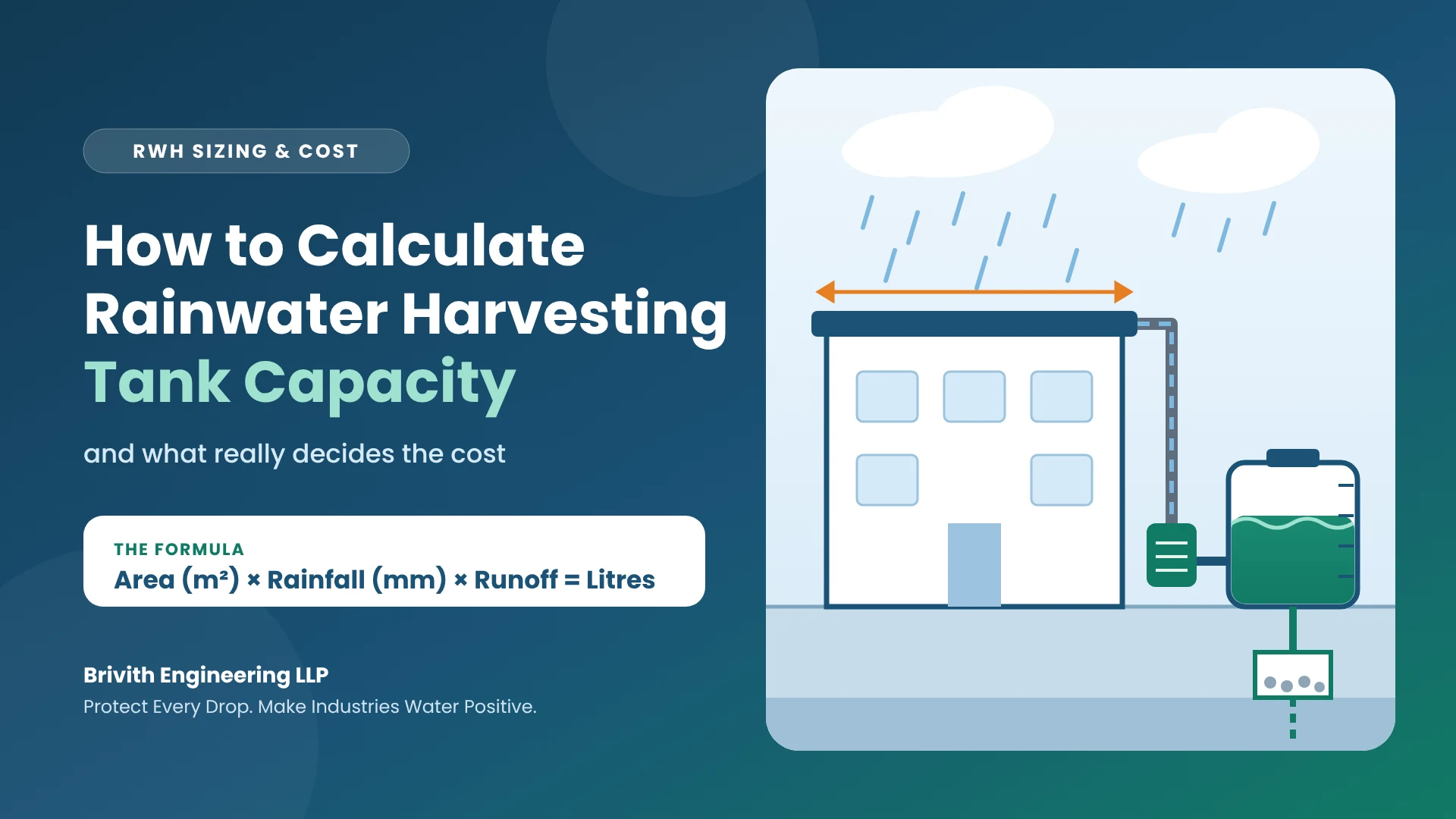
Rainwater harvesting tank capacity starts with one formula: catchment area (m²) × rainfall (mm) × runoff coefficient = litres. For example, a 1,000 m² RCC terrace in Pune can deliver about 6.5 lakh litres in a normal year. However, you never build a tank that big. Instead, you size the tank for a few days of use or one heavy rain day, whichever is smaller, and send the overflow to groundwater recharge.
Every housing society, factory and commercial building asks the same questions before it invests in rainwater harvesting. How do you calculate rainwater harvesting tank capacity? What size tank is needed? And what will the system cost? This guide answers each one with real numbers, so your committee or plant team can plan with confidence.
What is the formula for calculating rainwater harvesting?
The standard rainwater harvesting calculation multiplies three numbers: catchment area, rainfall and runoff coefficient.
The units work out neatly. One millimetre of rain on one square metre of roof equals exactly one litre of water. So a 100 m² roof receiving 10 mm of rain collects 1,000 litres before losses.
The runoff coefficient accounts for those losses. Some water soaks into the surface, evaporates or splashes away, so a smooth concrete roof delivers far more than a lawn. The Bureau of Indian Standards guideline IS 15998:2011 gives these planning ranges:
| Catchment surface | Runoff coefficient | What it means |
|---|---|---|
| Concrete (RCC) or tiled roof | 0.80 to 0.95 | Best catchment. We use 0.85 in the examples below. |
| Corrugated metal sheet roof | 0.70 to 0.90 | Good yield; common on factory sheds. |
| Paved areas (concrete or bitumen) | 0.70 to 0.85 | Useful extra catchment on larger plots, but needs more filtration. |
| Lawns on sandy soil, flat | 0.05 to 0.10 | Most rain soaks in, so it adds little runoff. |
Values are planning ranges from IS 15998:2011 and the Karnataka RWH trainers’ manual. Your engineer picks the final value after checking roof condition, slope and cleanliness.
RWH sizing: myth vs fact
Most oversized or underperforming systems come from four common beliefs. Tap each card to see the fact.
How much rainwater can be harvested in Pune?
A 1,000 m² concrete terrace in Pune can harvest about 6,48,550 litres in a normal year.
Here is the working. Pune (Shivajinagar) normally receives about 763 mm of rain a year, and roughly 79% of it falls between June and September, according to IMD data. Using a runoff coefficient of 0.85 for an RCC terrace:
1,000 m² × 763 mm × 0.85 = 6,48,550 litres a year (about 6.5 lakh litres)
A typical 1,000 sq ft bungalow roof, which is about 93 m², gives roughly 60,000 litres a year on the same basis. That is a meaningful volume for gardening, washing and borewell recharge.
However, the annual normal hides a lot of swing. In 2026, for instance, June brought only 64 mm against a normal of 152.9 mm, while July delivered 508.9 mm against a normal of 190 mm. Toggle the chart below to compare.
How do you calculate rainwater harvesting tank capacity?
Size the tank for how you will use the water, not for the full annual harvest. In practice, engineers run three checks and pick the smallest number that meets your goal.
- Check the demand. Estimate daily non-potable use, such as gardening, washing, flushing or cooling tower make-up. Then multiply it by the buffer days you want. For example, 5,000 litres a day for 5 days needs 25,000 litres.
- Check one heavy rain day. Multiply roof area by a design rainfall depth and the runoff coefficient. A 50 mm day on a 1,000 m² RCC terrace gives 1,000 × 50 × 0.85 = 42,500 litres. (Your engineer sets the design depth from local rainfall records.)
- Pick the smaller of the two. Here, that is 25,000 litres. A tank this size fills from about 29 mm of rain on that terrace, so it tops up on most good monsoon days.
- Route the rest to recharge. Everything above the tank’s capacity overflows to recharge pits, trenches or a recharge well, so no water goes to the drain.
- Fit it to the site. Finally, adjust for available space, structural load (for terrace tanks), budget and any treatment the water needs before use.
What size rainwater harvesting tank is needed for my roof?
Use this quick table as a starting point. It assumes a concrete roof (0.85) and Pune’s normal rainfall of 763 mm.
| Roof area | Typical building | Annual harvest | Water per 10 mm of rain |
|---|---|---|---|
| 100 m² (≈1,075 sq ft) | Bungalow or row house | ~64,900 L | 850 L |
| 250 m² | Small apartment building | ~1.62 lakh L | 2,125 L |
| 500 m² | Mid-size society wing or office | ~3.24 lakh L | 4,250 L |
| 1,000 m² | Large society or school | ~6.49 lakh L | 8,500 L |
| 2,500 m² | Factory shed or campus block | ~16.2 lakh L | 21,250 L |
The last column is the most useful for tank sizing. It tells you how quickly a given tank fills. For instance, a 10,000 litre tank on a 500 m² roof fills from roughly 24 mm of rain. So, if your daily use is modest, a smaller tank plus strong recharge often works better than a large tank.
Storage vs recharge: which should you choose?
Storage gives you water to reuse. Recharge puts water back into the ground. Most Pune buildings get the best value from a hybrid of both.
Choose storage when
- You have steady non-potable demand, such as a garden, washing or cooling tower.
- You buy tanker water in summer and want to cut it.
- You have space for a tank: underground, above ground or terrace.
Choose recharge when
- You depend on a borewell and want to improve its yield.
- Space for a large tank is limited.
- A percolation test shows the ground can absorb water at a useful rate.
Ground conditions matter here. Much of Pune lies on Deccan basalt, a hard-rock formation, so shallow pits do not always reach water-bearing layers. In such cases, a recharge well or borewell recharge often works better. Brivith designs this after studying soil, rock and groundwater depth on your site. Learn more on our rain water harvesting system page.
What decides the cost of rainwater harvesting?
Rainwater harvesting cost depends on six site factors, which is why an honest supplier will not quote a fixed price per square foot.
Two buildings with the same roof area can need very different systems. For example, one may simply connect downpipes to an existing sump, while another needs new piping, a filter chamber and a drilled recharge well through rock. Select a factor below to see what pushes cost up and what keeps it down.
Running cost is usually low, because the main tasks are cleaning gutters and filters before each monsoon and desilting recharge pits. On the savings side, the system cuts tanker and municipal water purchases. In addition, the Pune Municipal Corporation offers a property tax rebate for buildings with working rainwater harvesting, so check the current terms with PMC.
Is rainwater harvesting mandatory in Pune?
Yes, for new buildings. The Pune Municipal Corporation made rainwater harvesting a condition for building permission in 2006.
Rules are also widening to existing buildings. In August 2026, a Maharashtra government resolution required old buildings seeking new water or drainage connections to show provision for rainwater harvesting, under the state’s UDCPR and MRTP framework. Plot-size thresholds and design norms depend on the applicable regulations, so always confirm the requirement for your plot with the local planning authority.
Regulatory note: this section is for general understanding. Your sanctioned plan and the current UDCPR provisions are the binding documents.
How do you get the numbers right for your building?
Accurate sizing needs six inputs from your site, and you can collect most of them in a day.
- Measure the catchment. Use the roof’s plan area, plus any paved areas you want to include.
- Note the surface. Record roof material, slope and condition to pick the right runoff coefficient.
- Use local rainfall data. Take the long-term normal from IMD for your nearest station, not one unusual year.
- List your water uses. Estimate daily litres for gardening, washing, flushing or process needs.
- Test the ground. A percolation test and groundwater depth decide whether a pit, trench or recharge well suits you.
- Map the space. Mark where a tank, filter chamber and recharge structures can go, with access for cleaning.
Where your building also runs a sewage treatment plant, keep rainwater out of it. Monsoon inflow overloads an STP, so send rain to harvesting instead. Our guide Can we drink STP water? explains which water belongs where.
Summary
- Harvestable water (litres) = catchment area (m²) × rainfall (mm) × runoff coefficient.
- A 1,000 m² RCC terrace in Pune yields about 6.5 lakh litres in a normal year of ~763 mm.
- Size the tank for a few days of use or one heavy rain day, whichever is smaller, and recharge the overflow.
- Most Pune buildings benefit from a hybrid of storage and recharge, designed after a percolation test.
- Cost depends on catchment and pipes, filtration, recharge method, tank type, reuse plumbing and site conditions.
Frequently asked questions
How do you calculate rainwater harvesting tank capacity?
First calculate how much water your roof can deliver: catchment area (m²) × rainfall (mm) × runoff coefficient gives litres. Then size the tank for your use, not the whole year. Take the smaller of your daily non-potable demand multiplied by the buffer days you need, and the runoff from one heavy rain day. Send everything above that to recharge pits or wells.
What size rainwater harvesting tank do I need?
Most buildings need a tank that covers a few days of non-potable use, rather than months of storage. For example, a 1,000 m² RCC terrace in Pune that wants 5,000 litres a day for 5 days needs about 25,000 litres, with overflow going to groundwater recharge. Space, budget and water quality needs fine-tune the final number.
How much rainwater can be harvested from a 1,000 sq ft roof in Pune?
About 60,000 litres a year. A 1,000 sq ft roof is roughly 93 m². At Pune’s normal of about 763 mm and a runoff coefficient of 0.85, 93 × 763 × 0.85 gives roughly 60,250 litres. Actual yield changes every year with rainfall.
What is the cost of rainwater harvesting?
There is no fixed price, because cost depends on site conditions. The main drivers are catchment size and pipe runs, the filtration stages, the recharge method, the tank type and size, any pumps and reuse plumbing, and civil conditions such as excavation in hard rock. A site survey gives a reliable estimate.
What runoff coefficient should I use for a concrete roof?
IS 15998:2011 gives a range of 0.80 to 0.95 for concrete and tiled roofs. A value around 0.85 is a reasonable planning figure for a clean RCC terrace. Use a lower value if the roof is rough, dusty or covered with plants and storage.
Is storage or groundwater recharge better?
It depends on your goal. Storage gives you water to reuse but needs tank space and pumping. Recharge refills the aquifer and improves borewell yield but needs suitable soil or rock. Most societies and factories use a hybrid: a right-sized tank for reuse, with overflow sent to recharge.
Want us to run the numbers for your building?
Share your roof area and water use, and our engineers will size the tank, pick the right recharge method and explain what drives your cost. Call or WhatsApp +91 98600 88545.
Sources
- India Meteorological Department (IMD), Pune Shivajinagar rainfall normals, as reported by The Bridge Chronicle and Free Press Journal. Official data: mausam.imd.gov.in.
- Bureau of Indian Standards, IS 15998:2011 Rainwater Harvesting Systems: Guidelines. Summary via InfraLens.
- Karnataka Urban Infrastructure Development and Finance Corporation, RWH Trainers’ Manual, via India Water Portal.
- Pune Municipal Corporation RWH mandate and tax rebate, as reported by The Realty Today.
- Maharashtra Urban Development Department resolution on old buildings, August 2026, via PTI on ThePrint.
- Central Ground Water Board, rooftop rainwater harvesting guidance.
Protect Every Drop. Make Industries Water Positive.