What Does a Water Conditioner Do? Salt-Free Scale Control Explained
How a conditioner stops scale without removing hardness, what independent research found, when you need a softener instead, and why it is not the same as aquarium drops.
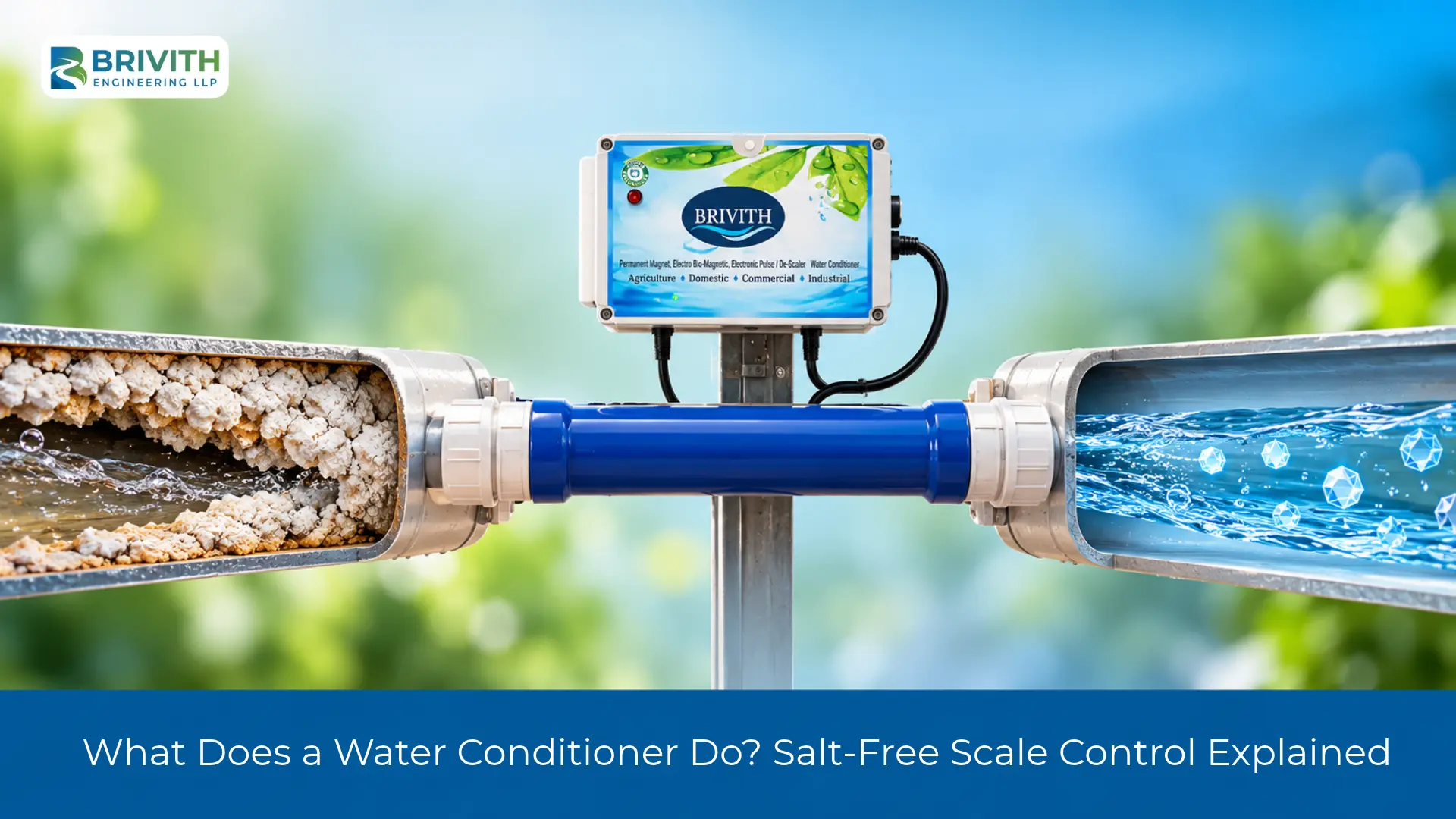
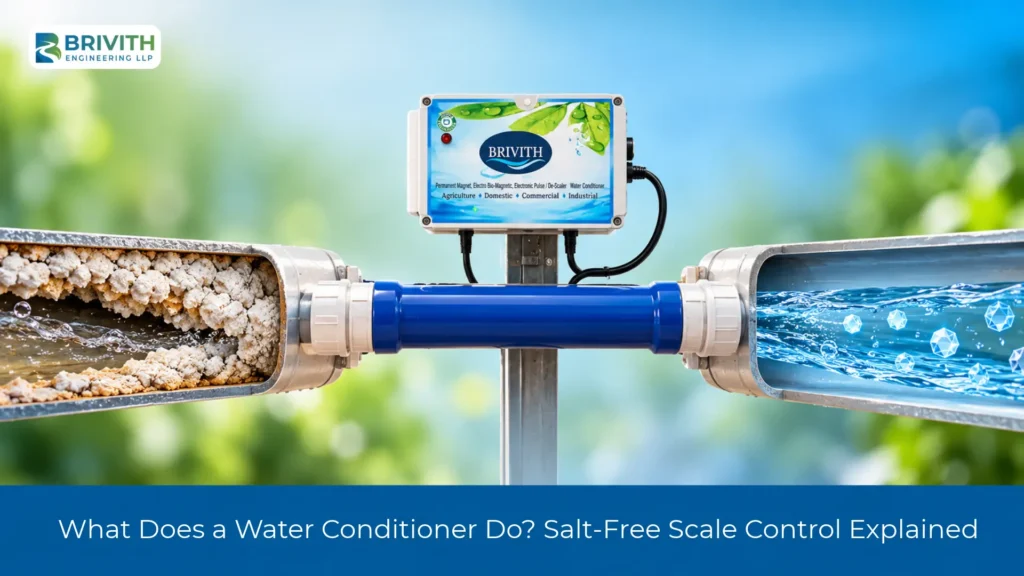
A water conditioner changes the way hardness minerals crystallise, so calcium and magnesium are less likely to stick to pipes and heaters as hard scale. It does not remove those minerals, so a hardness test reads the same before and after. It also works without salt, chemicals or regeneration, which means no wastewater. So if your goal is less scale rather than chemically soft water, a salt-free water conditioner is often the simplest fix.
Hard water is one of the most common reasons geysers fail early, pipes narrow and heat exchangers lose efficiency. That is why so many facility managers and homeowners ask what does a water conditioner do before they spend money on one. This guide answers that question in plain language. It covers what water conditioning means, how a conditioner works inside the pipe, what independent research found, and when a water softener is the better choice.
What does a water conditioner do?
A water conditioner reduces hard water scale without taking the hardness out of the water. It acts on dissolved calcium and magnesium as water flows through the pipe. As a result, the minerals form loose crystals that travel with the water instead of a hard crust that bonds to surfaces.
So, what does a water conditioner do for your building day to day? It helps you:
Protect hot equipment
Geysers, boilers, heat exchangers, chillers and solar heaters stay cleaner.
Keep water flowing
Pipelines, valves and shower heads stay open for longer.
Cut descaling
Less frequent cleaning and less downtime that comes with it.
Go salt-free
No salt, no chemicals and no regeneration water at all.
However, a conditioner does not purify water, reduce TDS or kill bacteria. It is a scale-control device, not a drinking water treatment system.
What is water conditioning?
Water conditioning means changing how the minerals in water behave, without changing what the water contains. Water treatment, by contrast, removes or adds something. For example, a softener removes hardness, an RO plant removes dissolved salts, and chlorination adds a disinfectant.
The difference matters because many products use the word loosely. “Water conditioner” can mean three different things:
Salt-free scale control
An inline device on your pipe that controls scale without salt.
A sales name for a softener
Some sellers call ion exchange softeners “conditioners”.
Aquarium dechlorinator
Liquid drops for fish tanks. See the difference.
How does a water conditioner work?
A water conditioner works by giving hardness minerals an easier place to crystallise than your pipe walls. To understand what does a water conditioner do inside the pipe, it helps to see how scale forms in the first place. Switch the pipe below to compare.
Inside a hot water pipe
How does scale form without a conditioner?
Hard water carries dissolved calcium and bicarbonate. When the water heats up or its pressure drops, these ions combine into calcium carbonate. Without treatment, the crystals grow directly on surfaces, especially hot ones like geyser elements and heat exchanger tubes. Layer by layer, they build a hard, rock-like crust. In the Arizona State University study, scale from untreated water was hard calcite that needed acid washing to remove.
What changes when water passes through a conditioner?
Tap a step to highlight it.
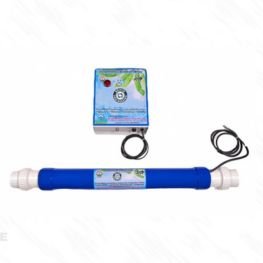
One principle, several technologies. Template-assisted crystallisation (TAC) uses media beads with built-in nucleation sites. Electronic and electromagnetic units use fields around the pipe. The Brivith Water Conditioner uses advanced ionization technology to alter the crystallisation behaviour of calcium and magnesium. In every case, the principle is the same: control where and how the crystals form.
Water conditioner myths vs facts
Most confusion comes from four common beliefs. Tap each card to see the fact.
Does a water conditioner remove hardness?
No. A water conditioner does not remove calcium or magnesium, so a lab hardness test reads the same before and after treatment. This is the single most important point to understand before you buy one.
Hardness test: same
Inlet and outlet read the same mg/L. That is normal.
Scale on surfaces: less
Crystals flow on instead of building a crust.
That has three practical consequences:
- Soap and detergent lather stays the same, because hardness still reacts with soap.
- You may still see white spots where water dries on glass or tiles, since the minerals are still present. However, these spots usually wipe off more easily.
- Processes with a hardness limit, such as many boiler feed and textile dyeing applications, still need a softener or DM plant.
On the positive side, the water keeps its natural minerals, and nothing is added to it. Unlike a softener, a conditioner does not swap calcium for sodium.
Water conditioner vs water softener vs RO: what is the difference?
A conditioner changes how hardness behaves, a softener removes hardness, and an RO plant removes almost all dissolved salts. Each one solves a different problem, so pick a tab to match the tool to the job.
Best for scale on pipes and heat transfer surfaces. See our water conditioner system.
Best for processes that need chemically soft water. See our industrial water softener plant.
Best for drinking, process or high-purity water. See our industrial RO plant.
Does a water conditioner actually work? What the research says
Salt-free conditioners can reduce scale significantly, but results depend on the technology and your water. The most cited independent work is a study led by Dr Peter Fox at Arizona State University for the WateReuse Research Foundation. It tested several alternatives to ion exchange softeners on domestic water heaters.
Scale reduction by salt-free technology
Arizona State University / WateReuse Research Foundation study. The dashed line marks the 80% DVGW W512 pass level.
DVGW W512 pass mark: 80%
Its key findings were clear:
- Every device tested reduced scale formation to some degree.
- Template-assisted crystallisation reduced scale formation by more than 88%.
- Electromagnetic treatment and electrically induced precipitation reduced scale by about 50%.
- Untreated water formed hard calcite scale, while scale after electromagnetic treatment was soft and easy to brush off.
Germany’s DVGW W512 protocol is the best-known test for these devices, and a device needs 80% scale reduction to pass. Still, there is no single global standard yet, and NSF has noted that the exact mechanisms remain an open question. Therefore, a trial on your own water is the most honest proof. That is exactly why Brivith offers a 30-day trial.
Is a water conditioner necessary?
A water conditioner is worth considering when your water is moderately hard or harder and scale is costing you money. If your water is soft, you probably do not need one. Enter your hardness reading to see where you stand.
Check your water hardness
Use the number from your water test report or a hardness test kit.
Expect frequent descaling. Choose a conditioner for scale control, or a softener if your boiler or process sets a hardness limit. This is above the BIS IS 10500 acceptable limit of 200 mg/L for drinking water.
| Hardness (mg/L as CaCO3) | USGS class | What it usually means for scale |
|---|---|---|
| 0 to 60 | Soft | Scale is rarely a problem |
| 61 to 120 | Moderately hard | Some spotting; heaters may need protection |
| 121 to 180 | Hard | Visible scale on heating elements and fittings |
| Over 180 | Very hard | Frequent descaling; choose conditioner or softener by application |
The last column is general guidance, not a design rule.
What are the signs you need one?
Tick what you see on your site.
When should you choose a softener instead?
Choose a softener when your boiler or equipment maker specifies a feed water hardness limit. Likewise, choose one when a process needs chemically soft water, such as laundry, textile dyeing or some food applications. In those cases, a conditioner alone will not meet the specification.
Quick check: conditioner, softener or RO?
Is a water conditioner the same as an aquarium water conditioner?
No. An aquarium water conditioner is a liquid you add to tap water to make it safe for fish, and it has nothing to do with hardness or scale. Many people searching “what does a water conditioner do” actually want this product, so the difference is worth spelling out.
Aquarium conditioners mainly neutralise chlorine and chloramine. Water suppliers add these disinfectants to make tap water safe for people, but they harm fish. Most aquarium conditioners rely on sodium thiosulfate, and many also bind heavy metals such as copper, zinc and lead.
Aquarium water conditioner
- Liquid drops added to water
- Makes tap water safe for fish
- Targets chlorine, chloramine and heavy metals
- Used in fish tanks and ponds
Salt-free pipeline conditioner
- Inline device fitted on a pipe
- Reduces hard water scale
- Targets scaling behaviour of calcium and magnesium
- Used in homes, buildings, boilers and heat exchangers
So, if you came here for fish tank advice, an aquarium specialist is the right stop. If you are fighting scale in pipes and heaters, read on.
Where does a water conditioner work best?
A water conditioner works best where scale on pipes and heat transfer surfaces is the main problem and chemically soft water is not required.
- Bungalows and villas
- Apartments and housing societies
- Geysers and solar water heaters
- Hotels and hospitals
- Schools and colleges
- Malls and office buildings
- Cooling towers
- Heat exchangers and chillers
- HVAC systems, RO pretreatment and process lines
For boilers, check the maker’s feed water specification first. If it sets a hardness limit, pair the boiler with a softener or DM plant.
How can you check if a water conditioner works on your water?
Measure scale before and after, on the same equipment, over the same period. A simple trial plan looks like this:
- 1Record a baselinePhotograph a heating element or exchanger and note your descaling interval.
- 2Test your hardnessYour starting point, even though the number will not change.
- 3Install inlineFit it on the supply to the equipment you want to protect.
- 4Run for 30 daysAvoid changing other variables during the trial.
- 5Compare resultsInspect the same surface, check how easily deposits wipe off, review flow and energy.
The Brivith Water Conditioner comes with a 30-day trial, a 2-year unconditional guarantee and a product life of up to 25 years. That way, you can verify results on your own system before you commit. Learn more on our water conditioner system page.
Summary
So, what does a water conditioner do? In short:
- A water conditioner changes how hardness minerals crystallise, so less hard scale sticks to pipes and heaters.
- It does not remove hardness, reduce TDS or disinfect water, and a hardness test reads the same.
- It needs no salt, no chemicals and no regeneration, so it wastes no water.
- Choose a softener when a process or equipment maker specifies a hardness limit.
- An aquarium water conditioner is a different product that neutralises chlorine for fish.
- A 30-day trial is the most reliable way to confirm results on your own water.
Frequently asked questions
What does a water conditioner do?
A water conditioner reduces hard water scale by changing how calcium and magnesium crystallise. The minerals form loose crystals that flow away instead of a hard crust on pipes and heaters. It does not remove the minerals and uses no salt or chemicals.
How does a water conditioner work?
Hard water passes through a conditioning zone that uses ionization, an electromagnetic field or special media, depending on the design. This triggers tiny seed crystals in the water, so the minerals crystallise there instead of on surfaces. The crystals stay suspended and leave with the flow.
Is a water conditioner necessary?
It is worth it if your water is moderately hard or harder, above about 60 mg/L as CaCO3 on the USGS scale, and scale is damaging geysers, heaters or exchangers. It is not needed for soft water. If your process specifies a hardness limit, choose a softener instead.
Is a water conditioner better than a water softener?
Neither is better in every case. A conditioner suits scale control with no salt, no maintenance and no wastewater. A softener suits processes that need chemically soft water, such as boiler feed with a hardness limit or textile dyeing.
Does a water conditioner make water safe to drink?
No. A water conditioner does not remove hardness, reduce TDS or disinfect water. For drinking water, you need treatment such as RO or filtration with disinfection, chosen after a proper water test.
Is a home water conditioner the same as an aquarium water conditioner?
No. An aquarium conditioner is a liquid that neutralises chlorine, chloramine and heavy metals to protect fish. A home or industrial water conditioner is an inline device that controls hard water scale in pipes and equipment.
Curious if it works on your water?
Ask us about the 30-day trial. Share your pipe size, flow rate and application, and our engineers will recommend the right unit and set up a trial on your system.
Sources
- U.S. Geological Survey, water hardness classification
- Bureau of Indian Standards, IS 10500:2012 Drinking Water Specification, summary via InfraLens
- WateReuse Research Foundation, Project 08-06: Evaluation of Alternatives to Domestic Ion Exchange Water Softeners (Arizona State University)
- Water Conditioning and Purification Magazine, DVGW W512 and physical water treatment and NSF on non-softening scale control devices
- API Fishcare, Tap Water Conditioner, and Aquarium Co-Op, What does water conditioner do?