Industrial Water Softener Plant: How It Works and Why It Pays Back
Soft Water. Better Efficiency. Longer Equipment Life.
An industrial water softener plant removes calcium and magnesium, the minerals that cause hardness, through a proven ion exchange process. As a result, it stops scale from forming inside boilers, cooling towers, heat exchangers and pipelines.
Brivith Engineering designs water softener plants from 500 LPH to 5,00,000 LPH and above. This guide explains how softening works, what the specifications mean and how to choose the right system for your plant.
*When the resin is correctly sized and regenerated on schedule.
What is an industrial water softener plant?
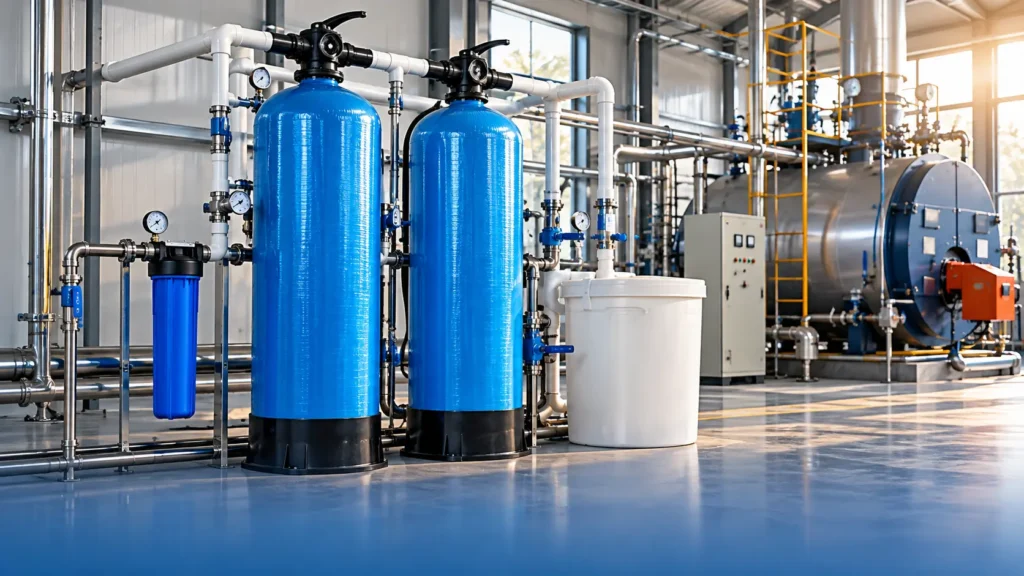
An industrial water softener plant is a pressure vessel system filled with food-grade strong acid cation exchange resin. As hard water flows through, the resin captures calcium (Ca) and magnesium (Mg) ions and releases sodium ions in their place.
The water that leaves the vessel is soft, so it no longer deposits scale when heated. Hard water is one of the leading causes of scaling, poor heat transfer, higher energy use and early equipment failure. That is why softening is often the first line of defence in a utility water system.
How does a water softener plant work?
A water softener plant works in a repeating cycle of service and regeneration. Once the resin is saturated with hardness, the system cleans and recharges it with salt brine, then returns to service.
In a fully automatic plant, a PLC, timer or flow meter triggers this cycle. Consequently, operators do not need to watch hardness levels manually, and the plant never runs on exhausted resin.
Plants that cannot stop for regeneration often use two vessels in duty and standby. While one vessel regenerates, the other keeps supplying soft water.
What are the specifications of a Brivith water softener plant?
Brivith water softener plants are built around standard specifications that we then tailor to your raw water hardness and flow.
| Specification | Value |
|---|---|
| Capacity range | 500 LPH to 5,00,000 LPH and above |
| Hardness removal | Up to 100% |
| Operating principle | Ion exchange technology |
| Resin type | Food grade strong acid cation exchange resin |
| Regenerant | Sodium chloride (common salt) |
| Operating pressure | 2.5 to 7.0 kg/cm² |
| Vessel material | FRP, MSRL, SS 304, SS 316 |
| Regeneration options | Manual, Semi-Auto, Fully Automatic |
| Automation | PLC based, timer or flow based regeneration |
Why does hard water cost your plant money?
Hard water costs money because scale acts as an insulating layer on every heated surface. The boiler or heat exchanger then burns more fuel to deliver the same output.
The damage builds up in four ways. First, fuel and power bills rise. Second, tubes and heat exchangers need frequent descaling. Third, scale causes overheating and early failure of expensive equipment. Finally, unplanned shutdowns interrupt production. For deeper reading on boiler and utility performance, the Bureau of Energy Efficiency publishes energy efficiency guidance for Indian industry.
Where is a water softener plant used?
A water softener plant is used wherever water is heated, cooled or used in contact with a product. The most common applications are listed below.
| Industrial Application | Commercial / Utility Application |
|---|---|
| Boilers and steam generation | Hotels and laundry systems |
| Cooling towers and HVAC | Hospitals and healthcare |
| Pharmaceutical manufacturing | Chemical industries |
| Food and beverage processing | Automobile and engineering industries |
What makes Brivith water softener plants different?
Brivith softeners are designed to run for years with low salt use and minimal attention. Here is what that means in practice.
Custom Design
Sized to your raw water hardness, flow and application.
Premium Resin
High-quality cation resin for maximum removal and long life.
Low Salt Use
Optimised regeneration keeps operating costs down.
Fully Automatic
Automated regeneration for uninterrupted soft water.
Energy Efficient
Low power design with simple, robust controls.
Turnkey Delivery
Design to AMC, backed by 25+ years of expertise.
What business benefits does a water softener plant deliver?
A water softener plant delivers savings on fuel, maintenance and downtime at the same time. In short, it protects both your utilities and your product.
- Prevents scale in pipelines, boilers, heat exchangers and cooling towers.
- Improves heat transfer, which reduces fuel and electricity consumption.
- Extends equipment life and protects valuable capital assets.
- Cuts maintenance cost and unplanned downtime.
- Improves product quality in food, pharma and process industries.
- Reduces chemical use because detergents and additives work better in soft water.
How do you size the right water softener plant?
You size a water softener plant from three numbers: raw water hardness, flow rate and the gap you can allow between regenerations. Work through these steps with your engineer.
- Test total hardness of your raw water, preferably across seasons.
- Measure peak and average flow in litres per hour.
- Decide regeneration frequency, for example once a day or once per shift.
- Choose simplex or duplex depending on whether you need 24×7 supply.
- Select vessel material based on water chemistry and hygiene needs.
- Pick the automation level, from manual valves to PLC control.
A softener removes hardness but not total dissolved salts. If your process needs low TDS, consider an industrial RO plant. For high-pressure boilers, a DM plant with mixed-bed polishing may be the better fit.
Key Takeaways
- A water softener plant removes calcium and magnesium through ion exchange and stops scale formation.
- Brivith softeners range from 500 LPH to 5,00,000 LPH with manual to fully automatic regeneration.
- Soft water improves heat transfer, cuts fuel use and extends equipment life.
- Correct sizing depends on hardness, flow and how often you can regenerate.
- See the full range on our Products page.
Frequently Asked Questions
What does an industrial water softener plant remove?
An industrial water softener plant removes hardness, mainly calcium and magnesium ions. It does not reduce total dissolved solids significantly. For TDS reduction, you need an RO plant.
How often does a water softener plant need regeneration?
Regeneration frequency depends on raw water hardness, flow and resin volume. Brivith sizes each plant so regeneration fits your operating pattern, such as once a day or once per shift.
How much salt does a water softener plant use?
Salt use depends on hardness load and regeneration settings. Brivith optimises the regeneration cycle to keep salt consumption low without compromising soft water quality.
Can a water softener protect my boiler?
Yes. Softened feed water prevents hardness scale on boiler tubes, which improves heat transfer and reduces fuel use. High-pressure boilers may also need DM water, so check your boiler maker’s feed water specification.
What is the difference between a softener and a water conditioner?
A softener chemically removes hardness ions using resin and salt. A water conditioner changes how hardness minerals crystallise so they form less scale, without removing them. The right choice depends on your application.
How long does softener resin last?
Resin life depends on feed water quality, chlorine levels and regeneration discipline. With good pre-filtration and regular AMC, industrial resin gives many years of service.
Is hard water costing your plant?
Send us your raw water hardness and daily flow. We will recommend the right softener capacity, vessel material and regeneration setup.
Protect Every Drop. Make Industries Water Positive.