Industrial RO Plant: How It Works, Key Specs and Where It Pays Off
Pure Water. Reliable Performance. Sustainable Future.
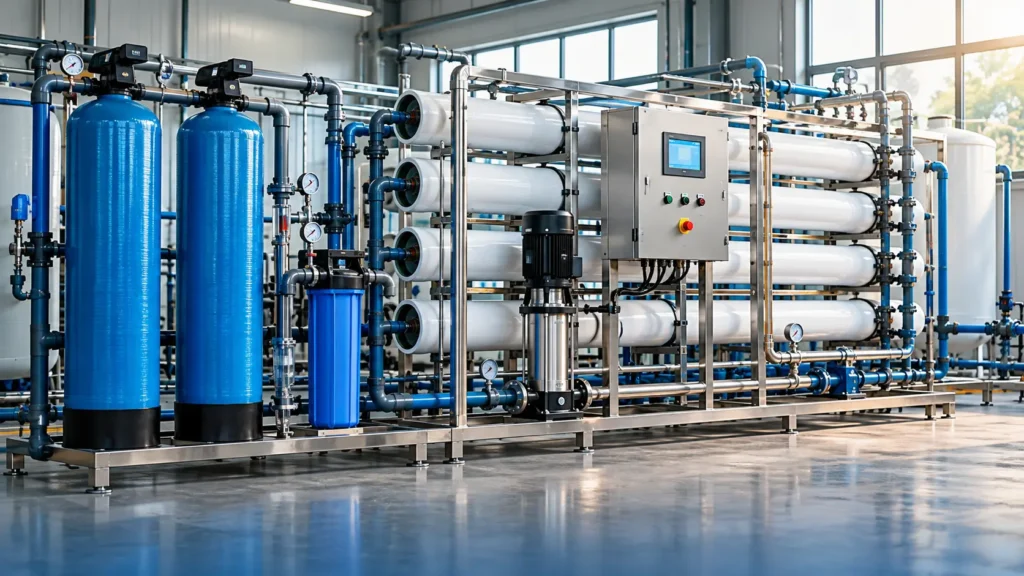
An industrial RO plant removes dissolved salts, minerals, bacteria, viruses and organic impurities from water by pushing it through semi-permeable membranes under high pressure. The result is consistent, high-purity water for process, utility and product use.
At Brivith Engineering, we design and build industrial RO plants from 250 LPH to 5,00,000 LPH and above. Each system is customised to your raw water analysis, output quality target and recovery goal. This guide explains how the technology works, what the specifications actually mean and how to choose the right plant for your facility.
*Recovery depends on raw water quality and system design.
What is an industrial RO plant?
An industrial RO plant is a reverse osmosis system built for continuous, high-volume water purification. It uses thin film composite (TFC) polyamide membranes that let water molecules pass while rejecting most dissolved salts and contaminants.
Unlike a domestic purifier, an industrial unit runs 24×7, handles variable feed water and must protect expensive downstream equipment. Therefore, the design goes far beyond the membrane itself. Pre-treatment, pump selection, recovery staging and automation all decide how well the plant performs over its life.
How does an industrial RO plant work?
An industrial RO plant works in six stages, moving from coarse filtration to membrane separation. Each stage protects the next, which is why skipping pre-treatment is the most common cause of early membrane failure.
Because every raw water source is different, we begin with a detailed water analysis. For instance, high iron or silica in borewell water changes the pre-treatment design completely.
What are the key specifications of a Brivith industrial RO plant?
The key specifications of a Brivith industrial RO plant cover capacity, TDS reduction, recovery, membrane type, pressure, automation and skid material. The table below summarises the standard range.
| Specification | Value |
|---|---|
| Capacity range | 250 LPH to 5,00,000 LPH and above |
| TDS reduction | Up to 80 to 90% (feed water dependent) |
| Recovery rate | 50 to 85% (depending on water quality) |
| Membrane type | Thin Film Composite (TFC), Polyamide, Low Energy, High Rejection |
| Operating pressure | 8 to 25 kg/cm² (based on feed TDS) |
| Automation | Manual, Semi-Auto, Fully Auto with PLC, SCADA and IoT |
| Skid material | MS Powder Coated, SS 304, SS 316 |
MS powder-coated skids suit most utility applications. However, pharma, food and beverage plants usually specify SS 304 or SS 316 for hygiene and corrosion resistance.
What recovery rate should you expect from an RO plant?
Most industrial RO plants deliver a recovery rate between 50% and 85%, depending on feed water quality and system design. Recovery is the share of feed water that becomes usable permeate.
Here is a simple example. At 75% recovery, a plant fed with 1,000 litres per hour produces 750 litres of permeate and 250 litres of reject. As a result, every extra percentage point of recovery means less water purchased and less reject to handle.
Pushing recovery too high, however, raises the risk of scaling. The right target balances water savings against membrane life. We explain this trade-off in detail in our guide to high-recovery RO technology.
Which industries use industrial RO plants?
Industrial RO plants serve almost every sector that needs consistent, low-TDS water. Brivith systems are commonly specified for the following applications.
| Industrial | Commercial | Process |
|---|---|---|
| Pharmaceutical | Food and Beverage | Chemical Industries |
| Automobile | Dairy Industries | Textile Industries |
| Hotels and Hospitals | Educational Institutions | Packaged Drinking Water |
| Boiler Feed Water | Cooling Tower Makeup | Process and Utility Water |
What makes Brivith industrial RO plants different?
Brivith RO plants are engineered around your water, not a catalogue model. That approach shows up in eight practical ways.
Custom Design
Every plant is designed from a detailed raw water analysis.
High Recovery
Staged design for maximum output and minimum reject.
Energy Efficient
Advanced pumps and low-energy membranes cut power use.
Premium Components
Quality membranes, pumps and valves for long-term reliability.
Modular Build
Compact skids that expand as your demand grows.
IoT Monitoring
Real-time data and alerts from anywhere.
Turnkey Delivery
Design, manufacturing, installation, commissioning and AMC.
25+ Years Expertise
Decades of hands-on water treatment engineering.
What business benefits does an industrial RO plant deliver?
An industrial RO plant pays off through better product quality, lower maintenance and longer equipment life. Specifically, facilities typically see five benefits.
- Consistent product quality because process water stays within specification.
- Lower maintenance cost since clean water prevents scaling and fouling downstream.
- Longer equipment life for boilers, cooling towers and process systems.
- Easier regulatory compliance with food, pharma and industrial water standards, such as those published by the Bureau of Indian Standards.
- Water conservation through high-recovery design that reduces fresh water intake.
How do you choose the right industrial RO plant capacity?
You choose the right industrial RO plant capacity by starting with water data, not a price list. Follow these six steps before you request a quotation.
- Test your raw water for TDS, hardness, silica, iron and organics.
- Calculate daily demand and peak hourly draw, then add a margin for growth.
- Define output quality, for example the TDS limit your process or boiler needs.
- Set a recovery target and plan how you will handle or reuse the reject stream.
- Choose the automation level based on operator availability and monitoring needs.
- Plan for AMC so membranes are cleaned and replaced on schedule.
If hardness is your only problem, a water softener may be enough. On the other hand, high-pressure boilers and pharma processes often need a DM or mixed-bed polisher after RO. Read why in our article on mixed-bed DM plants.
Key Takeaways
- An industrial RO plant removes dissolved salts and contaminants using high-pressure membrane separation.
- Brivith builds plants from 250 LPH to 5,00,000 LPH, customised to your raw water analysis.
- Recovery typically ranges from 50% to 85%, and the right target balances savings against membrane life.
- Good pre-treatment, correct sizing and regular AMC decide long-term performance.
- Explore the full range on our Products page.
Frequently Asked Questions
What is the price of an industrial RO plant in India?
The price of an industrial RO plant depends on capacity, raw water quality, material of construction and automation level. A 500 LPH MS skid costs far less than a 50,000 LPH SS 316 system with SCADA. Share your water analysis and daily demand with Brivith for an accurate quotation.
How long do RO membranes last in an industrial plant?
RO membrane life depends on feed water quality, pre-treatment and cleaning discipline. Plants with good pre-treatment and regular clean-in-place maintenance get far longer membrane life than poorly maintained systems. An AMC helps you track performance and replace membranes on time.
What is the difference between TDS reduction and recovery rate?
TDS reduction measures how much dissolved salt the plant removes from the water. Recovery rate measures how much of the feed water becomes usable permeate. A good design optimises both at the same time.
Can an industrial RO plant treat borewell water?
Yes, an industrial RO plant can treat borewell water, provided the pre-treatment matches the water chemistry. Borewell water often carries high hardness, iron or silica, so a detailed analysis comes first.
Can I monitor my RO plant remotely?
Yes. Brivith offers PLC, SCADA and IoT-enabled RO plants that send real-time data and alerts. As a result, you can track flow, pressure and permeate quality from a phone or control room.
What happens to the reject water from an RO plant?
Reject water can be sent to a drain, reused for low-grade applications or treated further in a ZLD scheme. High-recovery design reduces the reject volume in the first place.
Need a customised industrial RO plant?
Share your raw water report and daily demand. Our engineers will recommend the right capacity, recovery target and automation level for your plant.
Protect Every Drop. Make Industries Water Positive.